


You pull a beautiful, crusty loaf out of the oven. It looks perfect. But when you slice into it, the middle is heavy, wet, and feels almost raw.
This is incredibly frustrating, but do not worry. If you are looking for a reliable sourdough gummy crumb troubleshooting fix, you are in the right place. We are going to skip the fluff and diagnose exactly what went wrong so you can bake the perfect loaf next time.
Why Your Sourdough Is Gummy Inside (Simple Explanation)
A gummy inside happens when moisture gets trapped inside your bread.
During a successful bake, heat travels through the dough’s air pockets, turning water into steam. But if your dough lacks a strong gluten structure usually due to poor fermentation those air pockets never form.
Without air pockets, the heat cannot move through the loaf properly. The water gets trapped, acting like glue. This leaves you with a heavy, dense sourdough center instead of a light, fluffy crumb.
The 5 Root Causes of Gummy Sourdough Crumb
To stop your bread from turning out wet, we first need to identify the mistake. Here are the five most common reasons for a gummy crumb:
Underproofing: The dough did not ferment long enough to build air pockets. This is the most common reason for a dense, gummy texture.
Overhydration (Too Much Water): Using more water than your flour can absorb creates a wet dough that cannot hold its shape or bake through properly.
Incorrect Bulk Fermentation Timing: Stopping fermentation too early or letting it go too long destroys the dough’s strength.
Low Internal Baking Temperature: Pulling the bread out of the oven before the center is fully cooked leaves raw moisture inside.
Weak Oven Spring or Poor Scoring: If the bread cannot expand upward in the oven, the crumb compresses into a tight, damp block.
Diagnostic Decision Table
Use this wet crumb troubleshooting chart to figure out exactly what happened to your loaf.
| Crumb Symptom | Likely Cause | How to Confirm | Exact Fix |
| Dense + sticky center | Underproofed dough | Dough feels tight, low rise | Extend bulk fermentation by 30–60 min |
| Wet/gummy streaks | Overhydration | Dough too slack | Reduce hydration by 5–10% |
| Raw glue-like texture | Low internal temp | Bread under 95°C (203°F) | Bake longer until 96–98°C |
| Heavy compact crumb | Weak oven spring | Poor scoring or shaping | Improve tension shaping |
| Uneven holes + gummy patches | Fermentation imbalance | Irregular bubble structure | Adjust proof timing |
How to Know When Sourdough Is Fully Baked
Never guess if your bread is done. Use these clear benchmarks to ensure a perfect sourdough internal temperature done rate:
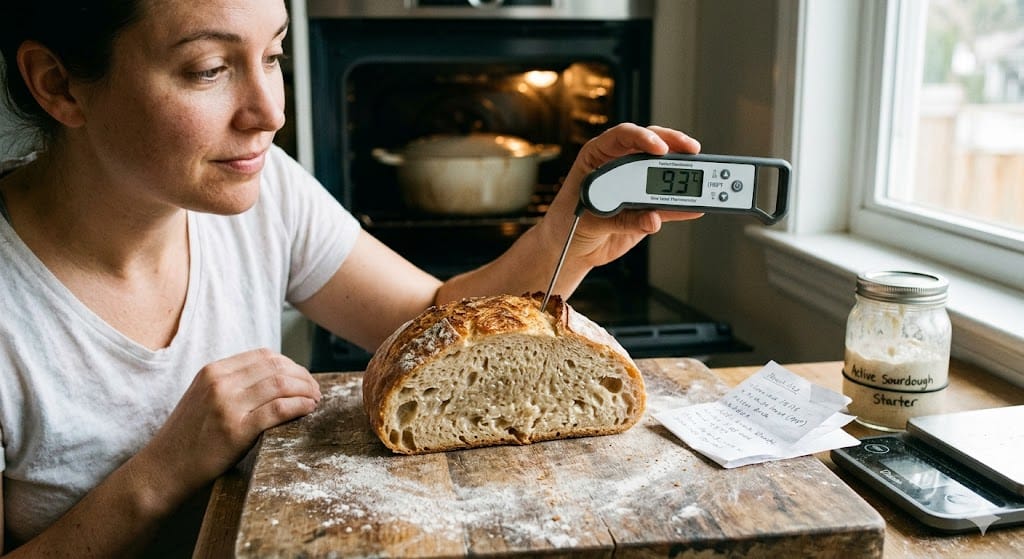
Internal Temperature: The very center of the loaf must reach 96–98°C (205–208°F).
Golden Crust Color: The outside should be a deep, rich brown, not pale.
Hollow Sound: When you tap the bottom of the loaf, it should sound hollow, like a drum.
Stable Shape After Cooling: The bread should hold its structure and not sink as it cools on the rack.
Bulk Fermentation Signs Most Bakers Miss
A proper underproofed sourdough diagnosis usually points straight to bulk fermentation. To ensure bulk fermentation signs completion, look for these specific cues before shaping:
Dough Doubles in Size: The dough should noticeably expand in your bowl.
Bubbles Visible at Edges: You should see active air bubbles popping on the sides and top.
Jiggly Dough Texture: When you gently shake the bowl, the dough should jiggle like a bowl of jelly.
Smooth Elastic Surface: The top should look domed, smooth, and slightly shiny.
Oven Spring Failure Explained
Oven spring is the final burst of rising your dough does in the hot oven. An oven spring sourdough failure leads directly to a gummy center. Here is why it happens:
Weak Gluten Structure: The dough cannot trap the gases expanding in the heat.
Overproofing Collapse: The yeast has run out of food, and the structure collapses under its own weight.
Low Steam in Oven: Without steam, the crust hardens too fast, trapping the dough inside before it can rise.
Scoring Mistakes: If you do not score the dough deeply enough, the steam cannot escape, forcing the loaf to bake tightly onto itself.
Sourdough Gummy Crumb Troubleshooting Fix: Step-by-Step Guide
Ready for your gummy bread fix? Follow these simple recovery steps for your next bake:
Adjust Hydration: If your flour struggles to absorb water, drop your water content by 5–10%. A lower hydration ratio dense crumb is much easier to avoid than a wet one.
Fix Fermentation Timing: Let your dough rest in a warm spot (around 24–26°C or 75–78°F) until it is jiggly and visibly larger.
Improve Shaping Tension: When shaping, pull the dough tight. A tight outer “skin” forces the bread to rise up, not out.
Use a Thermometer: Always use an instant-read meat thermometer to check the center of the loaf. Do not take it out until it hits 96°C (205°F).
Control Oven Steam: Bake your bread in a covered Dutch oven for the first 20 minutes to trap steam, allowing the loaf to expand fully before the crust sets.
Cool Completely: Never cut warm sourdough. Let it rest for at least 2 to 4 hours on a wire rack. Cutting early releases steam and instantly turns the crumb to gum.
Frequently Asked Questions (FAQ)
Why is my sourdough gummy after cooling?
You likely cut into the bread before it was completely cool, or the loaf was underbaked. Bread continues to bake and set from the residual heat while it cools. Cutting it too soon traps the steam inside, turning the crumb to glue.
How do I fix underproofed sourdough?
To fix underproofing, you must extend your bulk fermentation time. Ensure your dough is kept in a warm environment (around 24–26°C) and wait until it doubles in size, shows bubbles on the surface, and jiggles when shaken.
What internal temperature should sourdough reach?
Fully baked sourdough must reach an internal temperature between 96°C and 98°C (205°F to 208°F). Always insert the thermometer into the exact center of the loaf to get an accurate reading.
Can too much water cause gummy bread?
Yes. Overhydration is a common cause of a wet crumb. If your flour cannot absorb all the water in your recipe, the excess moisture gets trapped during baking. Try reducing your water by 5% to 10% on your next bake.
Why does my sourdough look baked but is raw inside?
Your oven temperature might be too high, causing the outside to brown rapidly before the heat can penetrate the center. Alternatively, your dough was too dense (from underproofing) to let the heat travel through the air pockets.