

If you have recently discovered that your blood sugar is creeping up, or you are struggling with stubborn central obesity and afternoon energy crashes, you are not alone. Millions of people face these exact metabolic challenges.
When it comes to reversing insulin resistance naturally 90 days is a clinically relevant timeframe to see measurable, significant improvements in your metabolic health.
Consider a common patient scenario: Sarah, a 42-year-old with normal fasting glucose but elevated fasting insulin. She constantly felt tired and struggled to lose abdominal weight.
Traditional models might tell her to “eat less and move more.” However, by addressing her underlying hyperinsulinemia through a targeted lifestyle approach, she can stop the progression toward Type 2 Diabetes.
This comprehensive guide breaks down the physiology of insulin resistance. Furthermore, it provides an evidence-based roadmap aligned with the American Diabetes Association (ADA) Standards of Care.
You will learn exactly why fasting insulin matters, how your cells process energy, and the steps required to reclaim your metabolic flexibility.
What Is Insulin Resistance?
To understand how to fix the problem, you must first understand how the system works. Insulin is a critical hormone produced by your pancreas.
Consequently, its primary job is to unlock your cells, allowing glucose from your bloodstream to enter and be used for energy.
When you consume carbohydrates, your digestive system breaks them down into glucose. Therefore, your blood sugar rises.
The pancreas senses this rise and secretes insulin. Under ideal, metabolically healthy conditions, your cells respond quickly. The glucose enters the cells, and your blood sugar returns to normal.
However, over time, factors like a high-glycemic diet, chronic stress, poor sleep, and a sedentary lifestyle can overload this system. Your cells become “deaf” to insulin’s signal. This state is called Insulin Resistance. Because the cells resist the signal, the pancreas must pump out even more insulin to force the glucose inside.
Early warning signs often include:
Increasing visceral fat (belly fat)
Skin tags or acanthosis nigricans (darkening of skin in creases)
Severe post-meal fatigue
Sugar cravings
Ultimately, if left unchecked, the pancreas cannot keep up with the extreme demand for insulin. Consequently, blood sugar levels rise, leading directly to Prediabetes and eventually Type 2 Diabetes.
How Do You Know If You Have Insulin Resistance?
Physicians typically rely on standard blood panels to assess metabolic health. However, a standard fasting glucose test alone is insufficient. Glucose is often the last marker to become abnormal. Fasting insulin, conversely, can elevate years, or even decades, before your glucose rises.
HOMA-IR Score Interpretation
The Homeostatic Model Assessment for Insulin Resistance (HOMA-IR) is the gold-standard calculation for early detection. By looking at the relationship between your glucose and your insulin, this score reveals how hard your body works to maintain balance.
For individuals dedicated to reversing insulin resistance naturally 90 days of consistent lifestyle changes can significantly lower this score. Here is how to interpret your results.
| HOMA-IR Score | Interpretation | Clinical Relevance |
| Below 1.0 | Optimal | Excellent insulin sensitivity; minimal risk of metabolic syndrome. |
| 1.0 – 1.9 | Early/Mild Resistance | Early warning sign. Lifestyle interventions are highly effective here. |
| 2.0 – 2.9 | Moderate Resistance | Cellular resistance is established. Pancreas is overworking. |
| 3.0 and Above | Significant Resistance | High risk for Prediabetes and Type 2 Diabetes. Immediate action required. |
Fasting Insulin Normal Range USA
Understanding your fasting insulin is critical. Unfortunately, standard laboratory reference ranges in the USA often reflect the average of an increasingly metabolically unhealthy population.
Functional medicine and endocrinology experts look for optimal ranges, not just “normal” ranges. While a lab might flag insulin as high only when it surpasses 15 $\mu\text{U/mL}$, metabolic damage occurs long before that threshold.
| Reference Standard | Fasting Insulin Range (μU/mL) | Meaning |
| Optimal/Healthy | 2.0 – 5.0 | Peak metabolic efficiency and sensitivity. |
| Early Warning | 6.0 – 10.0 | Pancreas is beginning to over-secrete to manage glucose. |
| Standard US Lab “Normal” | Up to 15.0 – 24.0 | Technically “in range” for many labs, but indicates severe resistance. |
| Elevated/Pathological | > 15.0 (Optimal criteria) | High risk for progressing to Type 2 Diabetes. |
Can Insulin Resistance Be Reversed?
The term “reversal” in clinical metabolic health means returning to a state of normal cellular insulin sensitivity, thereby normalizing fasting insulin, HbA1c, and HOMA-IR scores without the requirement of glucose-lowering medications.
Take the scenario of John, a 55-year-old diagnosed with prediabetes during a routine physical. He experienced fatigue and carried significant visceral fat. By following an evidence-based protocol, John was able to reduce his HbA1c from 6.2% to 5.4%, cut his fasting insulin in half, and lose 15 pounds of central adiposity.
However, expectations must remain realistic. Reversal does not mean you can return to a diet of highly processed carbohydrates without consequence. It means restoring metabolic flexibility. Success requires sustained improvements in visceral fat reduction, glucose metabolism, and muscular health.
Reversing Insulin Resistance Naturally: 90-Day Protocol
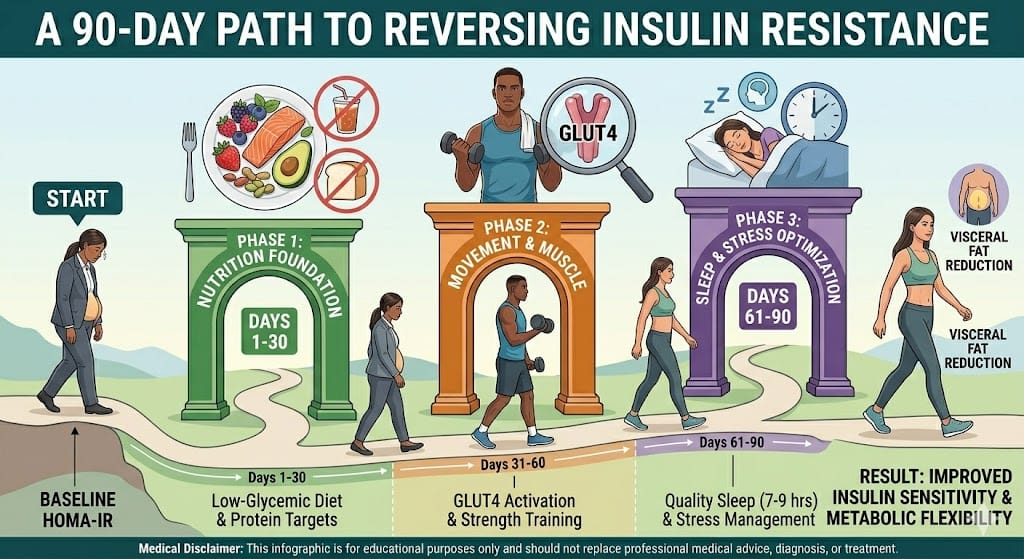
To effectively transform your metabolic health, you must approach the problem systematically. A multi-phase approach allows you to build sustainable habits.
| Phase | Duration | Primary Focus | Key Mechanisms Addressed |
| Phase 1 | Days 1–30 | Nutrition Foundation | Lowering glycemic load, reducing insulin spikes. |
| Phase 2 | Days 31–60 | Movement & Muscle | Enhancing muscular glucose uptake (GLUT4). |
| Phase 3 | Days 61–90 | Sleep & Stress | Lowering cortisol, restoring circadian metabolic rhythms. |
Phase 1 (Days 1–30): Nutrition Foundation
You cannot out-exercise a diet that constantly demands massive insulin surges. Therefore, the first 30 days focus entirely on stabilizing blood sugar and giving your pancreas a rest.
Low-Glycemic Diet Insulin Sensitivity Strategy
Transitioning to a low-glycemic diet prevents the rapid blood sugar spikes that trigger massive insulin dumps. According to recent Diabetes Care lifestyle intervention trials, minimizing processed carbohydrates is the most rapid way to lower fasting insulin.
Protein Targets: Consume 30 grams of high-quality protein per meal. Protein promotes satiety and stimulates glucagon, a hormone that counters insulin.
Fiber Intake: Aim for 30 to 40 grams of fiber daily. Soluble fiber slows gastric emptying, thereby blunting the glucose response of any meal.
Carbohydrate Quality: Shift from acellular carbohydrates (flours, sugars) to cellular carbohydrates (vegetables, intact whole grains, beans).
Meal Timing: Stop grazing. Eating 5 to 6 times a day keeps insulin constantly elevated. Stick to 2 or 3 structured meals.
Foods to Prioritize
| Category | Examples | Metabolic Benefit |
| Cruceriferous Veggies | Broccoli, cauliflower, Brussels sprouts | High fiber, low glycemic impact. |
| Quality Proteins | Wild salmon, grass-fed beef, eggs, tofu | Stabilizes blood sugar, preserves lean mass. |
| Healthy Fats | Avocados, olive oil, macadamia nuts | Zero insulin response; promotes satiety. |
| Berries | Raspberries, blackberries, blueberries | Rich in polyphenols that improve sensitivity. |
Foods to Limit
| Category | Examples | Metabolic Consequence |
| Liquid Sugars | Soda, fruit juice, sweetened coffee | Rapid glucose spike, massive insulin surge. |
| Refined Grains | White bread, pasta, pastries | Behaves like pure sugar in the bloodstream. |
| Seed Oils | Soybean oil, corn oil | May drive cellular inflammation and resistance. |
| Ultra-Processed | Packaged snacks, fast food | Hyper-palatable, promotes overeating and fat storage. |
Phase 2 (Days 31–60): Movement & Muscle Building
Once your nutrition is stabilized, the next step involves utilizing your body’s largest glucose sink: your skeletal muscle.
Strength Training Glucose Uptake GLUT4
When exploring the science behind reversing insulin resistance naturally 90 days of resistance training is non-negotiable. Skeletal muscle holds approximately 80% of the glucose cleared from your blood after a meal.
Inside your muscle cells are transporter proteins called GLUT4. When you are insulin resistant, insulin fails to signal GLUT4 to come to the cell surface to grab glucose. However, mechanical muscle contraction bypasses insulin entirely. When you lift weights, your muscles pull GLUT4 to the cell membrane without needing insulin. This is known as insulin-independent glucose uptake.
Furthermore, building more muscle expands your “storage tank” for glucose.
Beginner Strength Training Plan
| Day | Workout Focus | Key Exercises | Duration |
| Monday | Full Body Resistance | Goblet squats, push-ups, dumbbell rows | 30–40 mins |
| Tuesday | Active Recovery | Brisk walking (Zone 2 cardio) | 45 mins |
| Wednesday | Full Body Resistance | Lunges, dumbbell presses, plank holds | 30–40 mins |
| Thursday | Active Recovery | Brisk walking or cycling | 45 mins |
| Friday | Full Body Resistance | Deadlifts (kettlebell), overhead press | 30–40 mins |
| Weekend | Leisure Activity | Hiking, gardening, swimming | Variable |
Walking Recommendation: Commit to a 10-minute walk immediately following your largest meal. Post-prandial walking utilizes the glucose circulating in your blood, blunting the insulin response by up to 30%.
Phase 3 (Days 61–90): Sleep and Stress Optimization
By month three, nutrition and exercise are habits. Now, we optimize the neuroendocrine system. You can eat perfectly and exercise daily, but if you sleep poorly, you will remain insulin resistant.
Short sleep duration (less than 6 hours) and poor sleep consistency drastically decrease insulin sensitivity. Just one night of severe sleep deprivation can induce acute insulin resistance.
This happens because poor sleep elevates cortisol, your body’s primary stress hormone. Cortisol’s evolutionary job is to dump stored glucose into the bloodstream to fuel a “fight or flight” response. Consequently, this forces your pancreas to release more insulin.
To optimize this phase:
Maintain a rigid sleep schedule, going to bed and waking up at the exact same time.
Aim for 7 to 9 hours of quality sleep.
Practice stress management techniques such as box breathing, meditation, or restorative yoga to lower baseline cortisol.
Time-Restricted Eating and Insulin Resistance
Time-Restricted Eating (TRE) or intermittent fasting is a powerful tool to accelerate metabolic healing. By confining your eating to a specific window, you provide your body with a prolonged period where insulin levels drop to baseline.
During the fasting window, with insulin low, your body shifts from storing fat to utilizing stored visceral fat for energy (lipolysis). Recent trials show that eating early in the day aligns better with our circadian rhythm, yielding superior improvements in glucose control.
However, TRE is not for everyone. Pregnant women, individuals with a history of eating disorders, and those on specific glucose-lowering medications should consult a physician before fasting.
| Eating Pattern | Potential Benefits | Considerations |
| 12:12 (Overnight Fast) | Excellent starting point; improves sleep quality. | Easy to sustain long-term; minimal side effects. |
| 16:8 (E.g., 10 AM – 6 PM) | Significant reduction in fasting insulin; promotes visceral fat loss. | Requires skipping breakfast or dinner; may cause initial hunger. |
| Early TRE (E.g., 8 AM – 4 PM) | Aligns with circadian rhythms; highest insulin sensitivity in morning. | Can interfere with evening social events and family dinners. |
Sample 7-Day Meal Plan
This low-glycemic, high-protein meal plan is designed to minimize insulin secretion while keeping you full and energized.
Monday
Breakfast: 3-egg omelet with spinach, mushrooms, and feta cheese.
Lunch: Large mixed greens salad with 5 oz grilled chicken, avocado, and olive oil dressing.
Dinner: Baked salmon with roasted Brussels sprouts and asparagus.
Snack: Handful of macadamia nuts.
Tuesday
Breakfast: Full-fat Greek yogurt topped with chia seeds, flaxseeds, and raspberries.
Lunch: Leftover salmon over leafy greens with pumpkin seeds.
Dinner: Grass-fed beef stir-fry with broccoli and bell peppers (no rice).
Snack: Sliced cucumber with guacamole.
Wednesday
Breakfast: Protein smoothie (whey isolate, unsweetened almond milk, spinach, half an avocado).
Lunch: Turkey roll-ups (turkey breast, cheese, mustard wrapped in lettuce).
Dinner: Baked chicken thighs with a side of cauliflower mash.
Snack: Hard-boiled eggs.
Thursday
Breakfast: 3 scrambled eggs cooked in butter with a side of sliced avocado.
Lunch: Tuna salad (made with olive oil mayo) stuffed inside bell pepper halves.
Dinner: Zucchini noodles topped with ground turkey marinara sauce.
Snack: Almonds and a few blackberries.
Friday
Breakfast: Cottage cheese bowl with walnuts and cinnamon.
Lunch: Chicken and vegetable soup (clear broth, no noodles).
Dinner: Grilled shrimp skewers with a large side salad.
Snack: Celery sticks with almond butter.
Saturday
Breakfast: Frittata made with leftover vegetables and cheese.
Lunch: Burger patty (no bun) topped with avocado, side of roasted broccoli.
Dinner: Pork chops with green beans cooked in garlic and butter.
Snack: Olives.
Sunday
Breakfast: Smoked salmon, cream cheese, and capers on cucumber slices.
Lunch: Cobb salad with hard-boiled eggs, bacon, grilled chicken, and blue cheese.
Dinner: Steak with roasted asparagus and a side salad.
Snack: Pecans.
Tracking Progress During the 90 Days
To ensure your efforts are working, you must track objective data. Guessing leads to frustration.
Clinically, we look at several lab markers. You should test your Fasting Insulin, Fasting Glucose, HbA1c, and calculate your HOMA-IR on Day 1 and again on Day 90.
In addition to bloodwork, track your physical metrics. Visceral fat reduction is a primary indicator of metabolic healing. Therefore, your waist circumference is actually a better metric to track than total body weight. A shrinking waistline indicates you are losing the dangerous, metabolically active fat around your organs. Finally, monitor your energy levels, particularly in the afternoon, as improved insulin sensitivity eliminates post-meal crashes.
Using a Continuous Glucose Monitor (CGM) can also provide invaluable insights into how specific foods impact your unique biology.
Printable Self-Tracking Table
Print this table and keep it on your refrigerator. Log your metrics weekly to maintain accountability throughout the protocol.
| Week | Weight (lbs/kg) | Waist Circumference (in/cm) | Fasting Glucose (mg/dL) | Fasting Insulin (μU/mL) | Energy Score (1-10) | Exercise Sessions | Sleep Hours (Avg) |
| Wk 1 | |||||||
| Wk 2 | N/A | N/A | |||||
| Wk 3 | N/A | N/A | |||||
| Wk 4 | |||||||
| Wk 5 | N/A | N/A | |||||
| Wk 6 | N/A | N/A | |||||
| Wk 7 | N/A | N/A | |||||
| Wk 8 | |||||||
| Wk 9 | N/A | N/A | |||||
| Wk 10 | N/A | N/A | |||||
| Wk 11 | N/A | N/A | |||||
| Wk 12 |
(Note: Blood markers like fasting glucose and insulin are best tested at baseline, midpoint, and end of the 90 days, rather than weekly).
Common Mistakes That Slow Insulin Resistance Improvement
Even highly motivated individuals can plateau. If you are not seeing progress, check for these common pitfalls:
Excessive Cardio Without Resistance Training: Running for hours raises cortisol and does little to build the muscle mass necessary for long-term glucose disposal. Prioritize strength training.
Undereating Protein: Skimping on protein leads to muscle loss during weight loss, which worsens insulin resistance. Furthermore, inadequate protein intake is one of the common factors discussed when addressing weight loss resistance causes fix strategies, as it also drives hunger and cravings.
Poor Sleep Habits: Staying up late scrolling on your phone suppresses melatonin and elevates cortisol, directly destroying the next day’s insulin sensitivity.
Chronic Stress: Mental stress triggers the exact same metabolic response as a physical threat. If you do not manage stress, your liver will continue dumping glucose into your blood.
Inconsistent Tracking: “Diet creep” is real. Without tracking your carbohydrate intake or fasting windows, portions gradually increase.
When Lifestyle Changes May Not Be Enough
While lifestyle interventions are powerful, they are not a cure-all for every individual. We must separate evidence-based optimism from exaggerated promises.
Certain genetic factors can predispose individuals to severe insulin resistance regardless of their lifestyle. Furthermore, conditions like Polycystic Ovary Syndrome (PCOS) create a complex hormonal web that drives resistance, often requiring a multifaceted approach. Individuals with severe obesity or lipodystrophy may also struggle to normalize their markers through diet and exercise alone.
In these instances, medication considerations are entirely valid and necessary. Drugs like Metformin or GLP-1 receptor agonists can be vital tools. If you follow this protocol strictly for 90 days and see no improvement in your lab markers, a comprehensive physician evaluation is warranted. Do not view medication as a failure; view it as a bridge to better health.
Frequently Asked Questions
How long does it take to reverse insulin resistance?
While metabolic healing is an ongoing process, clinically significant improvements can be seen within weeks. For individuals committed to reversing insulin resistance naturally 90 days is widely considered the optimal benchmark to retest blood markers and observe substantial drops in HOMA-IR and HbA1c.
Can insulin resistance be reversed in 90 days?
Yes, for many individuals, 90 days of strict adherence to a low-glycemic diet, strength training, and proper sleep can completely normalize fasting insulin and glucose levels. However, outcomes vary based on starting severity, genetics, and adherence.
What is a good HOMA-IR score?
A functional, optimal HOMA-IR score is below 1.0, indicating excellent insulin sensitivity. Scores between 1.0 and 1.9 indicate early resistance, while anything over 2.0 suggests moderate to significant insulin resistance.
What fasting insulin level is considered healthy?
While standard US lab reference ranges often allow fasting insulin up to 15 or 24 $\mu\text{U/mL}$, metabolic experts and endocrinologists consider an optimal, healthy fasting insulin level to be strictly between 2.0 and 5.0 $\mu\text{U/mL}$.
Does walking improve insulin sensitivity?
Absolutely. Walking, especially a 10 to 15-minute brisk walk immediately after meals, promotes insulin-independent glucose uptake into the muscles, significantly lowering post-meal blood sugar spikes.
Is intermittent fasting effective?
Yes, intermittent fasting or time-restricted eating is highly effective. By reducing the eating window, you give your pancreas a rest, allowing insulin levels to fall, which triggers fat burning and improves cellular receptor sensitivity.
Can strength training lower insulin levels?
Strength training is one of the most potent tools available. Building muscle increases your body’s glucose storage capacity, and the act of lifting weights translocates GLUT4 receptors to clear glucose from the blood without the need for insulin.
Can insulin resistance return after improvement?
Yes, insulin resistance is a dynamic state. If you return to a sedentary lifestyle, poor sleep habits, and a diet high in processed carbohydrates, cellular resistance will return. The 90-day protocol must transition into a sustainable lifelong habit.
How does visceral fat affect insulin?
Visceral fat, the fat stored deep around your abdominal organs, is highly inflammatory. It secretes cytokines that actively interfere with insulin signaling, making it a primary driver of metabolic dysfunction.
Why is my fasting glucose normal but insulin high?
This is the hallmark of early metabolic dysfunction. Your pancreas is pumping out excess insulin to force your resistant cells to accept glucose. This compensatory hyperinsulinemia keeps your glucose normal for years before the pancreas finally exhausts itself.
Conclusion
Understanding your metabolic health is the most empowering step you can take for your longevity. By recognizing that hyperinsulinemia precedes high blood sugar, you can intervene before irreversible damage occurs.
The journey of reversing insulin resistance naturally 90 days at a time provides a clear, actionable framework to reclaim your health.
The core elements of this protocol transitioning to a low-glycemic diet, engaging in consistent strength training to activate GLUT4, practicing time-restricted eating, and prioritizing sleep are grounded in robust clinical research. They directly address the root causes of metabolic dysfunction rather than merely masking the symptoms.
However, realistic expectations are paramount. Healing a metabolism that took decades to deregulate requires consistency, patience, and objective tracking.
Use the provided tools, such as the HOMA-IR formula and the printable tracking sheet, to monitor your progress. Long-term lifestyle sustainability must be the ultimate goal.
The habits you build during these three months are not a temporary fix; they are the foundation for a vibrant, metabolically flexible life. Remember, your biology is adaptable. With the right inputs, significant improvement is not just possible it is highly achievable.