


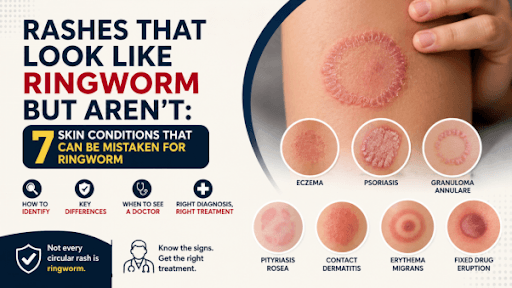
A circular rash often gets labelled as ringworm before anyone looks closely at its texture, border, or behaviour. In reality, many rashes that look like ringworm but aren’t come from eczema, immune reactions, medication sensitivity, or other skin disorders. Some itch. Some barely do. A few spread slowly, while others appear almost overnight. Because these conditions need different treatments, repeatedly applying an antifungal cream without knowing the cause can waste time and sometimes make the rash harder to assess.
Why a Circular Patch Is Not Enough for a Diagnosis
Ringworm is caused by dermatophyte fungi. It commonly creates a scaly patch that expands outward, often leaving the centre less inflamed than the edge. That familiar ring shape gives the infection its name, although real cases are not always perfectly round.
Skin colour also changes how a rash looks. On darker skin, inflammation may appear brown, purple, grey, or only slightly red. On lighter skin, the same condition may look bright pink or red. Doctors, therefore, pay attention to scale, speed of growth, body location, recent products, animal contact, medicines, and whether anyone else at home has a similar rash.
These details help separate ringworm from skin conditions similar to ringworm.
| Skin condition | What it may look like | Clue that points away from ringworm |
| Nummular eczema | Round, itchy, scaly patch | The centre often stays irritated |
| Granuloma annulare | Ring made of small bumps | Usually smooth rather than flaky |
| Pityriasis rosea | Oval patches on the trunk | New spots appear after one larger patch |
| Psoriasis | Thick, sharply edged plaque | May also affect nails, scalp, knees, or elbows |
Seven Conditions That Commonly Cause Confusion
There are a number of skin conditions that can resemble the round shape, redness or scaling often associated with ringworm. Differences often become clearer if you observe texture, location, itching and how the patch changes over time. Here are seven conditions that often cause that confusion.
1. Nummular Eczema
Nummular eczema creates coin-shaped patches, usually on the arms, legs, or torso. The skin may feel rough and dry, but some patches become wet, crusted, or intensely itchy.
Dry weather, frequent hot showers, harsh cleansers, and small skin injuries can trigger a flare. A ringworm look alike rash caused by eczema often stays red or irritated through the centre. Ringworm is more likely to have an active, scaly border that slowly moves outward.
2. Granuloma Annulare
Granuloma annulare is easy to mistake for ringworm from a distance. Up close, the difference becomes clearer. The ring is usually formed by firm, skin-coloured, pink, or reddish bumps rather than a continuous scaly edge.
It often appears on the hands, feet, wrists, or ankles. Most patches do not itch much. Some disappear without treatment, although a dermatologist may suggest medication if the condition becomes widespread or persistent.
3. Pityriasis Rosea
This rash commonly starts with one large oval patch, often on the chest or back. Doctors call it a herald patch. Several days later, smaller patches begin appearing across the trunk.
The sequence is the giveaway. Most circular skin rash causes do not follow this one-patch-first pattern. Pityriasis rosea may itch, especially when the skin gets warm, but it usually clears gradually without antifungal treatment.
4. Plaque Psoriasis
In psoriasis, skin cells grow more quickly than the body can slough them off. This leads to thicker plaques with sharp borders and visible scale.
A small plaque can look almost identical to ringworm. Other signs help. Psoriasis may appear on both knees or elbows, spread into the scalp, or cause tiny dents in the nails. It may also return in the same areas during stress, illness, cold weather, or after skin injury.
5. Contact Dermatitis
Contact dermatitis starts when the skin reacts to a substance. Nickel, fragrance, hair dye, adhesive, cosmetics, soaps, plants, and cleaning products are common triggers.
The rash may burn, itch, blister, or leak clear fluid. During a fungal infection vs rash assessment, shape can tell part of the story. A patch that matches a watch, necklace, bandage, shoe edge, or cosmetic product is more likely to reflect contact exposure.
6. Erythema Migrans
Erythema migrans can develop after a tick bite and may be an early sign of Lyme disease. It often expands over several days. Some patches develop central clearing, but the classic bull’s-eye appearance does not occur in every case.
The rash is generally warm and not very scaly. Fatigue, headache, fever, body aches, or swollen lymph nodes may appear as well. Possible tick exposure followed by an enlarging patch should not be treated casually.
7. Fixed Drug Eruption
A fixed drug eruption appears after the body reacts to a particular medicine. The patch often returns to exactly the same spot each time the medication is taken.
It may begin as a round red or purple area, then become sore, blistered, or darker as it heals. A recurring red rash not ringworm deserves a medication review, especially when it appears shortly after taking pain relievers, antibiotics, or another recently started drug.
When Home Treatment Is Not Enough
Seek medical advice if the rash develops quickly, is painful, produces pus, affects the face or genitals or appears after starting a medicine. Fever, breathing difficulty, facial swelling, mouth sores, or widespread blistering need urgent care.
A rash that keeps returning also deserves attention. So does one that looks worse after treatment. Avoid using a strong steroid cream on an undiagnosed patch. Steroids can reduce redness while allowing a fungal infection to spread underneath, creating a less typical appearance.
Final Perspective
The safest way to approach rashes that look like ringworm but aren’t is to notice more than the ring. Look at the scale, centre, border, location, timing, and anything that touched the skin before the rash appeared. My Healthy Topics supports informed health decisions, but skin conditions can overlap too closely for confident self-diagnosis. Before beginning a new cream, medicine, supplement, or skin-care regimen, speak with a primary care physician who can examine the area properly and recommend appropriate care.
FAQs
1. What rashes look like ringworm but aren’t?
Several conditions resemble ringworm, including nummular eczema, psoriasis, granuloma annulare, pityriasis rosea, contact dermatitis, erythema migrans, and fixed drug eruption.
2. How can you tell if a rash is not ringworm?
A rash may not be ringworm if it lacks a scaly border, does not expand outward, remains inflamed in the center, or is associated with medication use, allergies, or autoimmune conditions.
3. Can eczema look like ringworm?
Yes. Nummular eczema often causes round, itchy patches that closely resemble ringworm but are not caused by a fungal infection.
4. What skin conditions are commonly mistaken for ringworm?
Common ringworm look-alikes include eczema, psoriasis, granuloma annulare, pityriasis rosea, contact dermatitis, Lyme disease rash, and drug eruptions.
5. Should you use antifungal cream on every circular rash?
No. Using antifungal cream on a rash that is not caused by fungus may delay the correct diagnosis and appropriate treatment.
6. When should you see a doctor for a ring-shaped rash?
Seek medical care if the rash spreads rapidly, becomes painful, develops pus, occurs with fever, affects the face or genitals, or does not improve after treatment.