


Patients with allergic rhinitis often struggle to choose the right treatment path. Consequently, deciding between allergy shots and sublingual drops can feel overwhelming for those seeking relief.
Consulting a board-certified allergist is the most important first step. An expert can accurately evaluate your specific triggers and medical history to guide your choice.
Major health organizations, including the American Academy of Allergy, Asthma & Immunology (AAAAI) and the Centers for Disease Control and Prevention (CDC), heavily support immunotherapy. Ultimately, both treatment methods aim to retrain your immune system safely.
What Is SCIT vs. SLIT?
Allergy specialists primarily use two delivery methods for immunotherapy. First, SCIT stands for subcutaneous immunotherapy, which involves traditional, clinic-based allergy injections.
Second, SLIT stands for sublingual immunotherapy. This modern method utilizes dissolvable tablets or liquid drops placed directly under the tongue.
Both therapies share the exact same clinical mechanism. They introduce tiny amounts of an allergen to naturally build immune tolerance over time.
Efficacy Comparison: 2024–2025 Evidence
Patients frequently ask about allergy immunotherapy shots vs sublingual drops efficacy before committing. Therefore, looking at recent clinical data is crucial for an informed decision.
Recent Cochrane reviews confirm that both treatments are highly effective. Specifically, they successfully desensitize patients to common environmental triggers like dust mites, grass pollen, and cat allergens.
However, the medical data shows distinct clinical profiles. SCIT remains the gold standard for treating severe, multi-allergen profiles because it demonstrates slightly stronger long-term durability.
Meanwhile, Cochrane evidence strongly supports that SLIT reduces symptoms significantly compared to a placebo. As a result, it offers moderate efficacy combined with a notably strong safety profile.
Which Works Faster?
Patients understandably want rapid relief from their daily allergy symptoms. However, both treatments require patience because the necessary immune system changes happen gradually.
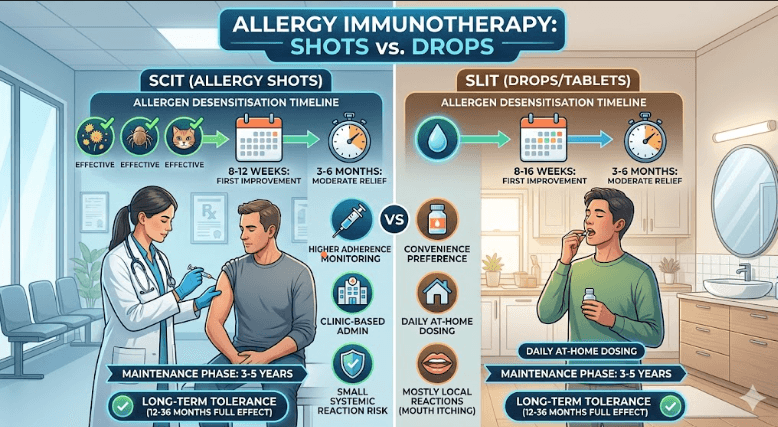
During an allergen desensitisation timeline comparison, both methods consistently show early improvement within 8 to 16 weeks. Furthermore, patients typically notice moderate, measurable symptom relief between 3 and 6 months.
Achieving a full, disease-modifying effect takes much longer. Therefore, you must commit to 12 to 36 months of consistent treatment for maximum results.
Side-by-Side Timeline Table
| Stage | SCIT (Allergy Shots) | SLIT (Drops/Tablets) |
| First improvement | 8–12 weeks | 8–16 weeks |
| Moderate relief | 3–6 months | 3–6 months |
| Strong symptom control | 6–12 months | 6–12 months |
| Maintenance phase | 3–5 years | 3–5 years |
| Long-term tolerance | High durability | Moderate–high durability |
SCIT (Allergy Shots) Protocol
The subcutaneous immunotherapy SCIT protocol always begins with a build-up phase. During this initial time, patients receive weekly clinic injections with gradually increasing allergen doses.
Next, patients transition into the allergy shot maintenance phase schedule, which usually requires monthly clinic visits. Because allergists administer these shots on-site, medical staff can easily monitor and guarantee your adherence.
SLIT (Drops/Tablets) Protocol
In contrast, the SLIT protocol relies entirely on daily at-home dosing. Consequently, patients must take their drops or tablets every single day to maintain clinical effectiveness.
Currently, SLIT tablet FDA approved allergens specifically include triggers like grass pollen, ragweed, and dust mites. In addition, some allergists prescribe custom liquid drops off-label to provide broader environmental coverage.
Safety Comparison
Safety remains a major priority when altering human immune responses. Fortunately, both therapies boast excellent safety records when administered correctly.
SCIT carries a small risk of severe systemic allergic reactions, including anaphylaxis. Therefore, clinics mandate that patients wait 30 minutes after every injection under strict medical supervision.
Conversely, at-home sublingual drop safety is exceptionally high. Patients mostly experience mild local reactions, such as mouth itching or throat irritation, while systemic reactions occur very rarely.
Cost Comparison
Financial factors often influence a patient’s final treatment decision. Generally, standard health insurance plans cover SCIT very well, though frequent clinic copays can accumulate quickly.
On the other hand, SLIT costs vary widely based on the exact format prescribed. While insurance often covers FDA-approved tablets, custom liquid drops usually require direct out-of-pocket payments.
2025 Clinical Consensus
Leading experts from the AAAAI and Cochrane groups strongly agree on current best practices. Specifically, they confirm both methods provide valid, highly effective pathways to lasting allergy relief.
Doctors still consider SCIT the medical gold standard for complex, multi-allergen cases. It consistently offers the strongest track record for robust, long-lasting clinical results.
However, specialists increasingly prefer SLIT for patients who prioritize convenience. Furthermore, it serves as an excellent, stress-free option for children or adults who strongly fear needles.
Who Should Choose What?
You should choose SCIT if you suffer from severe allergies involving multiple different triggers. Additionally, it perfectly suits patients who prefer professional clinic supervision over daily at-home routines.
Alternatively, you should choose SLIT if you have mild-to-moderate allergies. Moreover, it fits perfectly for busy individuals who heavily value treatment convenience and needle avoidance.
Frequently Asked Questions:
Which works faster: allergy shots or drops?
Both allergy shots and drops begin working within 8 to 16 weeks. However, shots (SCIT) often reach optimal immune durability slightly faster than drops (SLIT) due to direct systemic delivery.
Are allergy drops as effective as shots?
Yes, allergy drops are highly effective for symptom reduction. While shots remain the clinical gold standard for severe, multi-allergen cases, drops offer highly comparable relief for specific, targeted allergens.
How long does immunotherapy take to work?
You will likely notice early, moderate symptom relief in 3 to 6 months. However, achieving full, lasting immune tolerance requires 3 to 5 years of continuous, dedicated treatment.
Is SLIT safer than SCIT?
Yes, SLIT boasts a significantly higher safety profile. It primarily causes minor local reactions like mouth itching, whereas SCIT carries a small but real risk of systemic reactions requiring medical supervision.
Conclusion
Ultimately, there is no single “best” allergy treatment for everyone. While SCIT offers slightly faster durability, SLIT provides unmatched daily convenience for busy lifestyles.
Therefore, you must strictly individualize your choice based on your unique profile. Always work directly with a board-certified allergist to find the best, safest path forward.