


Maybe your father keeps asking the same question in one visit. Maybe your mother forgot an appointment she wrote down herself. Small moments like these raise a bigger question: Is this just normal ageing or something more, like are we talking about a weird little shift that might be more than it seems? The difference between dementia and Alzheimer’s confuses many families, since the two words often get used as if they mean the same thing. They don’t, and understanding how they relate makes it easier to know what to watch for.
What Is the Main Difference Between Dementia and Alzheimer’s?
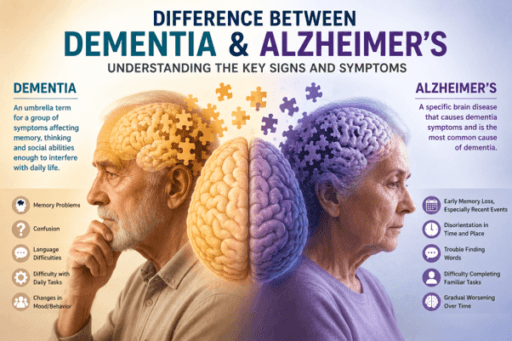
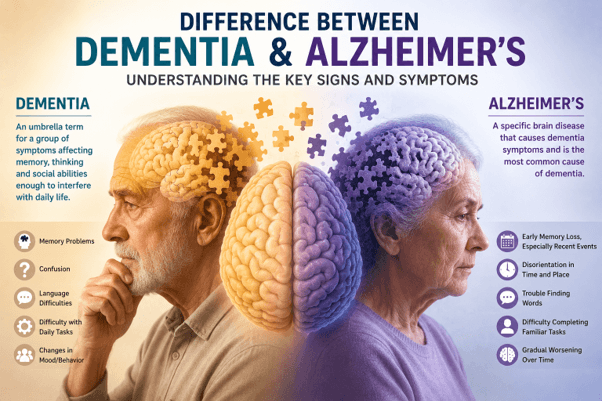
Dementia is not just one disease. It’s more like a general umbrella for a cluster of symptoms that can mess with a person’s memory, their way of thinking, and everyday routines enough that life gets disrupted in a very practical sense. Then, Alzheimer’s disease is a specific and diagnosable brain condition, and it’s also the most common cause of dementia. It can create real confusion, particularly for families trying to understand a diagnosis and what it means. When you know the distinction between dementia and Alzheimer’s, you’re better able to form realistic expectations about what happens next.
Dementia vs Alzheimer’s at a Glance
| Comparison Area | Dementia | Alzheimer’s Disease |
| Meaning | A general term for a set of symptoms affecting memory and thinking | A specific brain disease that causes dementia symptoms |
| Classification | Umbrella category with several possible types | One type, and the most common cause, of dementia |
| Common symptoms | Memory issues, confusion, language or judgment problems | Early memory loss, followed by broader cognitive decline |
| Possible causes | Alzheimer’s, vascular disease, Lewy body disease, and others | Complex brain changes involving nerve cell damage |
| Progression | Varies depending on the underlying cause | Typically gradual and gets worse over time |
| Diagnosis | Based on symptoms and functional decline | Confirmed through medical history, testing, and imaging |
What Is Dementia?
Think about dementia more like a clinical description, not as some single condition with one lone cause. It can touch memory, reasoning, language, decision making, conduct, and also a person’s ability to run day-to-day routines independently. A person living with dementia might have a hard time following a recipe they made for years, or they may get stuck when handling finances they used to manage so easily. It’s also good to be clear that not every instance of forgetfulness automatically means one of those memory loss disorders that clinicians check for. Misplacing keys once in a while, or drawing a blank on a name here and there, happens to people at almost any age.
What Is Alzheimer’s Disease?
Alzheimer’s disease is a particular, progressive brain disorder, and it’s the thing most people imagine when they hear the word dementia. Usually, it starts by messing with the brain areas responsible for forming new memories, so in the early phase, Alzheimer’s disease symptoms tend to be mostly about recent memory. Later on, it can also start interfering with communication, knowing what day or where you are, and being able to finish familiar day to day tasks. Still, not everyone experiences Alzheimer’s in the same order or at the exact same pace. Some people see personality changes early, while others first have trouble finding the right words. Since the disease moves along differently for each person, trying to line up one person’s schedule with someone else’s timeline often doesn’t really help all that much.
Key Signs and Symptoms to Notice
Occasional forgetfulness is a normal part of life. What matters more is a pattern of changes that persists and starts interfering with daily routines. Signs worth paying attention to include:
- Repeatedly losing track of something you just learned, like, over and over
- Asking the same question more than once, even when you know you already asked
- Having trouble organizing plans or working through familiar everyday issues
- Getting mixed up about time, dates, or where you are, like the map slips
- Struggling to grab the right words mid-conversation
- Misplacing things, then not being able to retrace your steps to locate them
- Making choices that feel off, that used to seem straightforward
Other Types of Dementia and Their Differences
Alzheimer’s isn’t the only condition under the dementia umbrella. There are several recognized types of dementia, and each affects the brain a little differently.
- Vascular dementia follows reduced blood flow to the brain and can affect planning and processing speed before memory.
- Lewy body dementia is linked to abnormal protein deposits and can sometimes bring about odd perceptions, like hallucinations.
- Frontotemporal dementia seems to have an effect on personality or on the way someone speaks earlier than memory does, often at a younger age than Alzheimer’s usually brings.
- Mixed dementia tends to happen when brain patterns change, and more than one type shows up together, which is pretty normal in older adults. But in practice, it can still look odd, because the mix is sometimes subtle, like a fading trail, and then suddenly it connects.
The earliest symptoms depend on which parts of the brain are affected first, so two people with dementia can have very different early experiences.
What Can Cause Cognitive Decline?
Memory and thinking can change without it automatically meaning a progressive brain disease; not every shift is the same. Getting a real handle on why cognitive decline cause matters, because some reasons are temporary or workable, while others aren’t. For example, vitamin deficiencies, thyroid issues, side effects from medicine, depression, and sleep problems can all mess with focus and memory. So that’s why a proper medical evaluation really matters, not just deciding the worst-case scenario based on symptoms alone.
When Should Someone Speak to a Doctor?
If it seems like memory, language, judgment, personality, or the ability to handle everyday tasks just keeps shifting over weeks or months, then it’s probably time to get a professional evaluation instead of doing a wait and see thing. A healthcare provider usually starts with medical history and current meds, then moves to cognitive testing, a physical or neurological exam, lab work, and brain imaging if it really makes sense.
Final Thoughts
Dementia describes a pattern of symptoms, and Alzheimer’s disease is the most common specific condition behind that pattern. Understanding the difference between dementia and Alzheimer’s won’t change a diagnosis, but it can change how a family approaches the next steps. Paying attention early and involving a healthcare professional gives people the clearest path forward, along with the compassion this journey deserves.
FAQ’s
1. Is dementia the same as Alzheimer’s?
No. Dementia is a general term for symptoms affecting memory and thinking, while Alzheimer’s is a specific disease and the most common cause of dementia.
2. What is usually the first sign of Alzheimer’s?
The earliest sign is typically difficulty forming new memories, such as forgetting recent conversations or repeating questions.
3. Can dementia symptoms be caused by something other than Alzheimer’s?
Yes. Vitamin deficiencies, thyroid problems, medication side effects, depression, and sleep issues can all cause memory and focus problems that mimic dementia.
4. When should I take a parent to the doctor for memory concerns?
If changes in memory, judgement, or daily functioning persist over weeks or months, it’s time for a professional evaluation rather than waiting.
5. Are there different types of dementia besides Alzheimer’s?
Yes, vascular dementia, Lewy body dementia, frontotemporal dementia, and mixed dementia are other recognised types, each affecting the brain differently.






Rất đáng đọc, cảm ơn tác giả. Công ty Letco cung cấp dịch vụ du học Hàn Quốc trọn gói, tư vấn tận tâm và minh bạch chi phí. Tìm hiểu tại letco.vn.