


If you’ve started researching laser eye surgery, you’ve probably run into two names again and again. Deciding between LASIK vs. PRK trips up a lot of people, since both promise sharper vision without glasses or contacts. The difference lies in how each one gets there. Your cornea’s shape and thickness, your daily routine, and even your job or hobbies all feed into which one a surgeon might recommend.
What Are LASIK and PRK?
At their core, LASIK and PRK are both vision correction procedures built around the same tool, an excimer laser used to reshape the cornea so light lands correctly on the retina. They differ in how the surgeon gets to the tissue that needs to be treated, so in the end, you get a different path, even if the idea is fairly similar.
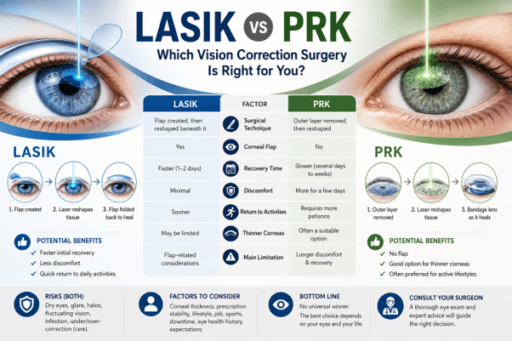
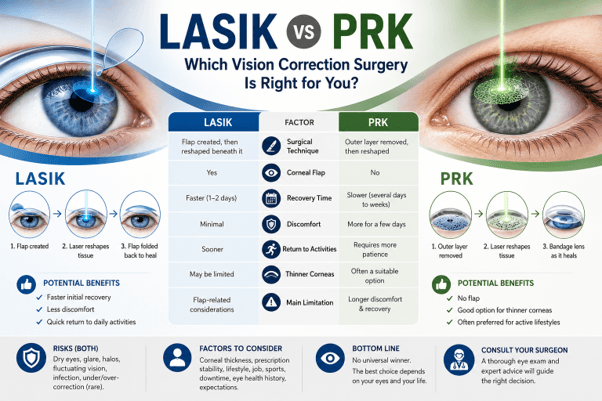
How LASIK Works
With LASIK, the surgeon first makes a thin flap on the outer cornea, either by laser or with a very exact surgical instrument. That flap lifts like a little hinge, the laser then reshapes the tissue underneath, and after that, the flap folds back into its place; usually, the whole thing heals on its own from there.
How PRK Works
PRK skips the flap entirely. The surgeon gently removes the outermost layer of cells on the cornea, called the epithelium, then reshapes the surface underneath with the laser. Afterward, a soft bandage contact lens goes over the eye so those cells can grow back naturally.
LASIK vs PRK: Key Differences at a Glance
| Factor | LASIK | PRK |
| Surgical technique | A flap was created, then reshaped beneath it | Outer layer removed, then reshaped |
| Corneal flap | Yes | No |
| Typical early recovery | Often faster, within a day or two | Slower, often several days to weeks |
| Initial discomfort | Usually minimal | More noticeable for a few days |
| Return to routine activities | Often sooner | Requires more patience |
| Suitability for thinner corneas | May be limited | Often a suitable option |
| Considerations for contact sports | May carry flap-related concerns | Often preferred, no flap |
| Visual stabilisation | Weeks to a few months | Can take several months |
| Main limitations | Flap-related healing considerations | Longer discomfort and recovery |
Keep in mind, these are patterns, not promises. Healing looks different from person to person.
Potential Benefits of LASIK
A lot of people gravitate toward LASIK for its reputation for speed. The LASIK surgery benefits most patients notice include a quicker initial recovery, less discomfort in those first days, and a faster return to work and normal life. Nobody can guarantee this in advance, though; healing speed and final vision depend heavily on your own eyes.
Potential Benefits of PRK
PRK eye surgery tends to come up for thinner corneas, since there’s no flap to worry about. It’s also worth a conversation if you play contact sports, work a physically demanding job, or feel uneasy about a corneal flap. Even then, whether PRK makes sense comes down to a proper eye exam, not preference.
LASIK vs PRK Recovery: What Should Patients Expect?
Here’s where things get practical. LASIK vs PRK recovery looks fairly different in the first week or two. Both come with early discomfort, blurry or shifting vision, and light sensitivity, but the timeline diverges from there.
Whichever procedure you choose, expect instructions to avoid rubbing your eyes, wear protective shields at night for a while, and attend follow-up visits so your surgeon can track healing. Eye drops matter more than people expect; skipping doses can slow things down.
LASIK’s repositioned flap protects the eye almost immediately, which is part of why recovery often feels quicker. PRK asks for more patience since the surface has to regrow before vision settles and clears up.
Risks and Possible Side Effects
No surgery is risk-free. Dry eyes, glare, halos around lights, fluctuating vision, infection, and inflammation can happen with either LASIK or PRK. Under- or over-correction is also possible, sometimes calling for a follow-up enhancement. Serious complications are rare, but not zero.
LASIK’s added risk comes from the flap: displacement or uneven healing at the edges. PRK sidesteps that concern but trades it for more early discomfort and a longer wait for stable vision.
Who May Be a Better Candidate for LASIK?
Surgeons generally look for a stable prescription, corneas that are healthy and thick enough, no active eye disease, and expectations that match reality, plus the ability to stick to post-op instructions. Checking these boxes doesn’t guarantee eligibility, but it’s a reasonable starting point.
Who May Be a Better Candidate for PRK?
PRK often comes up for thinner or irregularly shaped corneas or anyone whose job or sport puts their eyes at higher risk of impact. If a corneal flap feels like a dealbreaker, your surgeon might lean toward PRK, though it means accepting a slower recovery.
Factors to Consider Before Choosing
A handful of things shape this laser eye surgery comparison more than anything else:
- Corneal thickness and shape
- How stable your prescription has been
- Any history of dry eyes
- What do you do for work
- Sports or physical activities
- How much downtime can you take
- Past eye conditions
- What you’re expecting from the outcome
- Your surgeon’s professional reading on your eyes
And if neither LASIK nor PRK is a great fit, other vision correction procedures are worth asking about.
Conclusion
There’s no universal winner in the lasik vs prk debate. It comes down to your eyes and your life. LASIK tends to offer a faster, more comfortable early recovery for people with corneas thick enough to support it. PRK earns its place when avoiding a flap matters more, whether that’s due to corneal thickness or an active lifestyle. Either way, the real answer comes from sitting down with a qualified eye surgeon who can examine your eyes and talk through what fits.
FAQ’s
- What is the main difference between LASIK and PRK?
LASIK creates a thin corneal flap before reshaping the eye, while PRK removes the outer layer of cells instead of creating a flap. - Which one has a faster recovery, LASIK or PRK?
LASIK typically offers a quicker initial recovery, often within a day or two, while PRK recovery can take several days to weeks. - Is PRK better for thin corneas than LASIK?
Yes, PRK is often a suitable option for people with thinner corneas since it doesn’t require a corneal flap. - Does LASIK or PRK hurt more after surgery?
PRK usually involves more discomfort in the first few days, while LASIK discomfort is typically minimal. - Can I play contact sports after LASIK or PRK?
PRK is often preferred for contact sport players since there’s no flap that could be affected by impact. - How do I know if I’m a good candidate for LASIK or PRK?
Candidacy depends on corneal thickness and shape, prescription stability, eye health history, and a proper evaluation by an eye surgeon.