


If you are noticing strange changes in your body like losing your sense of smell or acting out your dreams—you might be wondering if it is just normal aging. For some people, these changes are part of the prodromal Parkinson’s disease phase. Understanding the early signs before diagnosis can help you take control of your health and know when to seek medical advice.
This guide provides clear, neurologist-reviewed information about early Parkinson’s signs. We will explore the science, ease your worries, and explain exactly what these symptoms mean.
What is prodromal Parkinson’s disease?
Prodromal Parkinson’s disease is the early warning phase where non-motor symptoms appear, often years or even decades before classic movement issues begin.
During this time, a person does not have the visible signs of Parkinson’s, such as resting tremors, stiffness, or slow movement. Instead, the changes happen quietly in the background. Your daily life and functioning remain mostly normal, but underlying shifts are occurring in your brain, gut, and nervous system.
Why symptoms appear years before diagnosis
Symptoms appear years early because the disease often begins in the gut and the brain’s smell centers before reaching the areas that control movement.
Parkinson’s is linked to the buildup of a sticky protein called alpha-synuclein. This protein slowly spreads through the nervous system over a long period.
By the time physical tremors start, the brain has already lost a large amount of dopamine-producing cells. The prodromal phase simply reflects the early stages of this protein buildup in other parts of the body.
5 early warning signs explained simply
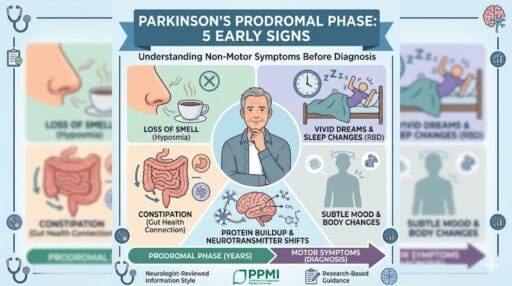
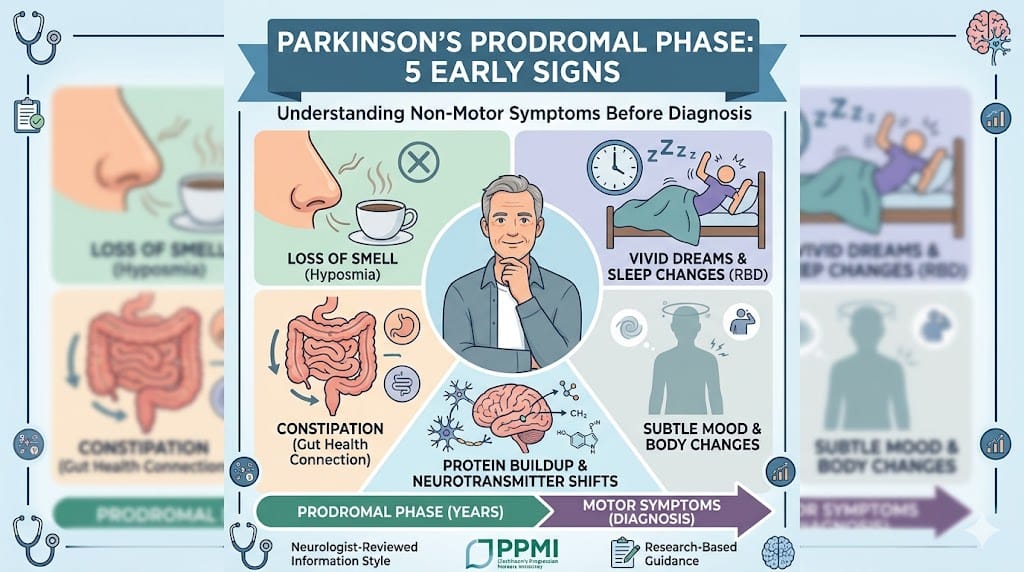
If you are checking your symptoms, here are five early non-motor signs that doctors look for:
1. Loss of smell (Hyposmia): Having trouble smelling foods like bananas, dill pickles, or licorice is a common red flag. Doctors consider this hyposmia an early Parkinson’s symptom to watch closely. It is usually a permanent loss, unlike the temporary loss from a cold.
2. Constipation: The gut is often affected long before the brain. The constipation and Parkinson’s association is very strong, with many patients reporting severe bowel slowness for years before their official diagnosis.
3. Vivid dreams and sleep movements: Acting out your dreams by thrashing, kicking, or yelling in your sleep is known as REM sleep behavior disorder (RBD). Because of the proven REM sleep behavior disorder Parkinson’s link, neurologists view this as one of the most reliable early warning signs.
4. Subtle mood changes: Unexplained depression, high anxiety, or a sudden lack of motivation (apathy) can appear. This happens because the brain’s natural mood chemicals, like serotonin and dopamine, are shifting.
5. Dizziness when standing: Feeling lightheaded or dizzy when you stand up is caused by a drop in blood pressure. This happens because the disease can affect the automatic nervous system that controls your blood flow.
Timeline table
This table shows a clinical timeline of how early these non-motor symptoms can appear before standard movement issues begin.
| Symptom | What happens in the body | Average years before motor symptoms | Evidence level |
| Constipation | Slowed gut movement | 10 to 20 years | High (PPMI data) |
| Loss of smell | Olfactory bulb changes | 5 to 10 years | High (PPMI data) |
| Vivid dreams (RBD) | Brainstem pathways affected | 5 to 15 years | Very High |
| Mood changes | Serotonin and dopamine shifts | 2 to 10 years | Moderate |
| Dizziness on standing | Blood pressure control issues | 1 to 5 years | Moderate |
What PPMI research shows about early biomarkers
Research from the Parkinson’s Progression Markers Initiative (PPMI) proves that we can now detect the disease’s biology years before physical symptoms start.
Backed by the Michael J. Fox Foundation, the PPMI study is changing how doctors understand the disease. Data from PPMI Parkinson’s progression markers shows that the disease leaves a biological footprint in the body.
A major recent breakthrough is the alpha-synuclein skin biopsy biomarker. This simple skin test, along with spinal fluid tests, can now detect the abnormal Parkinson’s protein in people who only have early prodromal symptoms.
When to see a doctor (neurology referral guide)
You should see a neurologist if you experience REM sleep behavior disorder, or if you have a combination of smell loss, chronic constipation, and mood changes without a clear medical cause.
Do not panic if you only have one symptom. Constipation and mood changes are very common in the general public.
However, if you are actively kicking or yelling in your sleep (RBD), it is highly recommended to ask your primary care doctor for a referral to a sleep specialist or a neurologist for a simple evaluation.
Final takeaway
Having one or two of these early signs does not guarantee you will develop Parkinson’s disease. Normal aging, medications, and other common health conditions can also cause these exact same changes.
The goal of learning about the prodromal phase is awareness, not fear. If you notice a cluster of these symptoms especially changes in how you sleep or smell talking to a doctor can give you peace of mind and keep you ahead of your health.
Frequently Asked Questions
Is loss of smell always Parkinson’s?
No. Losing your sense of smell can be caused by normal aging, sinus infections, allergies, or recent viruses. It is only a concern for Parkinson’s when combined with other specific symptoms.
How early can REM sleep disorder start?
REM sleep behavior disorder can begin up to 15 to 20 years before any physical tremors or stiffness appear.
Can constipation be the first sign?
Yes. The gut is often affected first, meaning severe, chronic constipation can be one of the earliest signs, sometimes starting decades early.
What tests detect early Parkinson’s?
Doctors can now use the alpha-synuclein skin biopsy biomarker and specific spinal fluid tests to find the disease early. These tests look for the specific proteins that cause the condition.
Should I worry if I have one symptom?
No. A single symptom like constipation or anxiety is rarely a cause for worry on its own. Doctors look for a pattern or cluster of these early signs before making a diagnosis.