

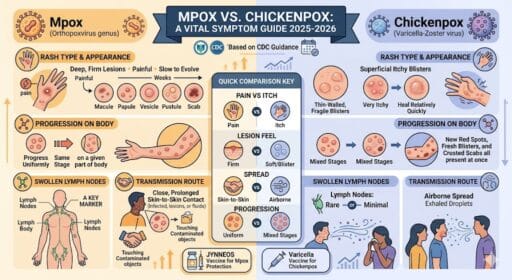

You or your child wakes up with a mysterious, bumpy rash. Naturally, panic sets in immediately as you wonder what to do next. Identifying the mpox vs chickenpox symptom differences adults and children face is critical for fast, appropriate care.
Furthermore, these rashes look very similar during their early phases. However, the Centers for Disease Control and Prevention (CDC) provides clear clinical guidance to help you distinguish between the two. Fortunately, you do not need to panic.
Therefore, carefully observing the timeline and physical features of the bumps provides the fastest answers.
What is Mpox vs. Chickenpox?
Importantly, these diseases originate from entirely different virus families. Mpox is a viral zoonotic infection. Specifically, it belongs to the orthopoxvirus genus.
Consequently, it behaves quite differently than common childhood ailments. Chickenpox stems from the varicella-zoster virus. This pathogen belongs to the herpesvirus family.
As a result, their treatment protocols differ significantly. Knowing the virus type dictates exactly how medical professionals will manage the infection.
Key Difference Table
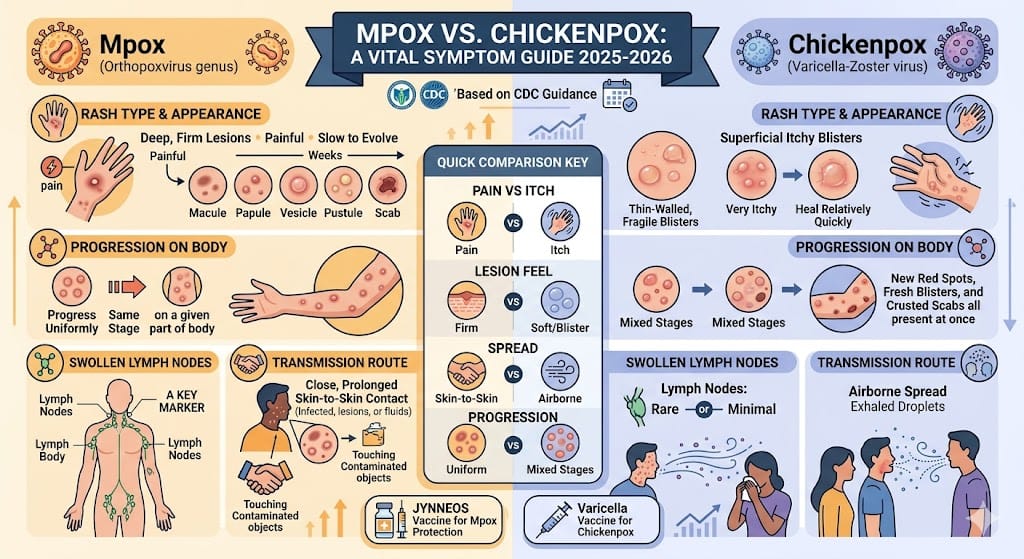
Therefore, doctors look for specific markers to make an initial clinical assessment. Use this table to understand the clinical signs.
| Feature | Mpox | Chickenpox |
| Rash type | Deep, firm lesions | Superficial itchy blisters |
| Progression | Same stage lesions | Mixed stages |
| Pain vs itch | Painful | Very itchy |
| Fever | Common early | Common early |
| Swollen lymph nodes | Yes (key marker) | Rare |
| Transmission | Close contact | Airborne + contact |
Rash Progression Comparison
Tracking the monkeypox rash progression stages 2025 guidelines reveals a very methodical timeline. First, the mpox rash starts as flat spots called macules.
Next, these spots become raised bumps (papules). Eventually, they turn into fluid-filled blisters (vesicles) and pus-filled bumps (pustules) before finally crusting over into scabs.
Crucially, mpox lesions on any specific part of the body progress together at the same time. In contrast, chickenpox features a multiple-stage rash at once.
Therefore, a person with chickenpox will have new flat red spots, fresh blisters, and older scabs all coexisting simultaneously. Furthermore, chickenpox heals relatively quickly, whereas mpox lesions can take two to four weeks to fully resolve.
Transmission Differences
Understanding mpox transmission routes vs chickenpox helps you determine your actual exposure risk. Mpox primarily requires close, prolonged physical contact.
Specifically, it spreads mostly through direct skin-to-skin contact with infected lesions, scabs, or bodily fluids. Additionally, touching contaminated objects like bedding can transmit the virus.
Conversely, chickenpox spreads easily through the air. An infected person exhales airborne droplets, which readily infect people nearby.
Consequently, chickenpox outbreaks occur rapidly in schools, whereas mpox clusters typically link back to specific, intimate contact networks.
Mpox vs. Herpes vs. Other Rashes
Often, doctors must also perform a rapid mpox vs herpes skin lesion comparison during an examination. Herpes typically presents as clusters of small, delicate, fluid-filled blisters.
Furthermore, herpes blisters break open easily and heal relatively quickly. Conversely, mpox produces larger, firm lesions that feel deeply rooted in the skin.
Unfortunately, misdiagnosis sometimes happens when patients only have one or two lesions. Therefore, doctors will frequently run laboratory tests to confirm the exact virus.
CDC 2025 Situation Overview
Public health authorities actively maintain robust monitoring systems nationwide. Currently, health officials use general surveillance networks to track the CDC mpox case count 2025 data locally and globally.
Importantly, they focus on identifying localized clusters rather than preparing for widespread airborne transmission. Thus, officials do not expect mpox to spread like a common respiratory cold.
Consequently, keeping an eye on official health department updates ensures you stay informed without falling for online misinformation.
Vaccine and Protection
Fortunately, proactive protection exists for high-risk individuals. The two-dose JYNNEOS vaccine provides excellent defense against orthopoxviruses.
Currently, JYNNEOS vaccine mpox eligibility generally includes people with known exposure to the virus. Additionally, it covers healthcare workers and individuals engaging in high-risk intimate activities in areas with known transmission.
Therefore, you should consult your local health department or doctor. They will determine if you qualify for the vaccine based on your specific exposure history.
When to Seek Medical Care
Knowing exactly when to escalate care prevents severe complications.
Go to the ER if you experience:
A high fever combined with a rapidly spreading rash.
Severe, unmanageable pain or sudden extreme weakness.
Lesions appearing near or inside your eyes or genitals.
Go to Urgent Care if you experience:
A highly suspicious rash following a known exposure event.
Noticeable lymph node swelling paired with firm skin bumps.
Consequently, early testing allows doctors to prescribe specialized antiviral medications if necessary.
Prevention Strategies
First, practicing excellent hand hygiene stops many viruses before they take hold. Wash your hands thoroughly and frequently with soap and water.
Second, actively avoid direct skin-to-skin contact with anyone displaying an unexplained rash. Furthermore, do not share towels, bedding, or clothing with them.
Finally, if you suspect an infection, isolate yourself immediately. Consequently, staying in a separate room protects your household members while you await laboratory results.
Conclusion
Ultimately, while the initial bumps might look similar, their progression and behavior tell a very different clinical story. Mpox creates painful, firm bumps that progress uniformly, whereas chickenpox causes extremely itchy, varied blisters.
Therefore, relying on CDC-backed guidance helps you make calm, informed health decisions. Most importantly, remain vigilant but avoid unnecessary panic, as effective treatments and vaccines remain readily available.
Frequently Asked Questions (FAQ)
How fast does mpox rash spread?
Typically, the mpox rash begins 3 to 17 days after exposure. Once it starts, the lesions progress slowly over two to four weeks. Consequently, it does not spread across the body overnight like some allergic reactions.
Can you have both infections at once?
While incredibly rare, it is biologically possible to contract two different viral infections simultaneously. However, doctors almost always identify just one underlying pathogen causing the rash.
Early warning signs before rash appears?
Yes, mpox usually begins with a distinct illness phase before any skin bumps emerge. Specifically, patients often experience fever, chills, intense muscle aches, exhaustion, and noticeably swollen lymph nodes. Therefore, these symptoms act as a vital early warning system.






Online Casino Ab 2 Euro Apple Pay (https://Hostealolatam.Com/) 10 euro mastercard