

Have you recently moved to a mountain city like Denver or Salt Lake City? If so, you have likely experienced the heartbreak of a sunken cake. Perhaps your cookies spread into a burnt puddle instead. You followed the recipe perfectly, yet the results were terrible. First, do not blame yourself. The culprit isn’t your oven or your skills. Instead, it is the elevation. When baking at high altitude, lower atmospheric pressure and a depressed boiling point drastically alter how ingredients interact. To reclaim your kitchen confidence, you need a precise high altitude baking adjustments formula by elevation. In this guide, we break down exactly how to alter your leavening agents, sugar, liquids, and flour across tiered elevations. As a result, you will confidently bake perfect cakes, cookies, and breads every single time.
How Do I Adjust Baking Recipes for High Altitude?
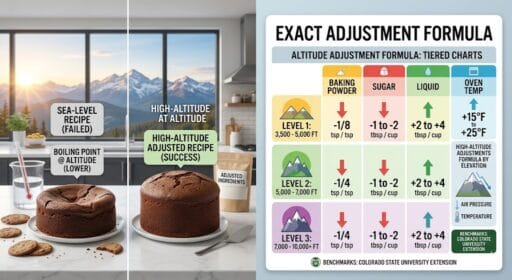
To adjust recipes for high altitude, you must use a tiered high altitude baking adjustments formula by elevation. For example, at 5,000 feet, decrease baking powder by 1/8 to 1/4 teaspoon per recipe. Additionally, reduce sugar by 1 to 2 tablespoons per cup. Finally, increase liquid by 2 to 4 tablespoons per cup. These baseline adjustments counteract lower atmospheric pressure. Ultimately, this allows your cakes and baked goods to set perfectly before they collapse.
The Science: Boiling Point of Water & Elevation Effects
Before applying a high altitude baking chart, you must understand why recipes fail above 3,500 feet. Primarily, the core issue involves atmospheric pressure and the boiling point of water elevation effect.
At sea level, water boils at 212°F. However, for every 500 feet you climb, the boiling point drops by roughly 1°F. Therefore, in Denver (5,280 feet), water boils at roughly 202°F.
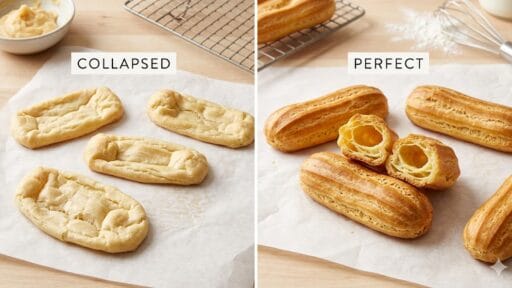
Because water evaporates at a lower temperature, liquids leave your batter much faster. Simultaneously, the lower atmospheric pressure makes leavening gases expand rapidly. Without adjusting recipes for altitude, your baked goods will expand too quickly. Then, they dry out and collapse before the oven heat can set their structure.
The Exact High Altitude Baking Adjustments Formula by Elevation
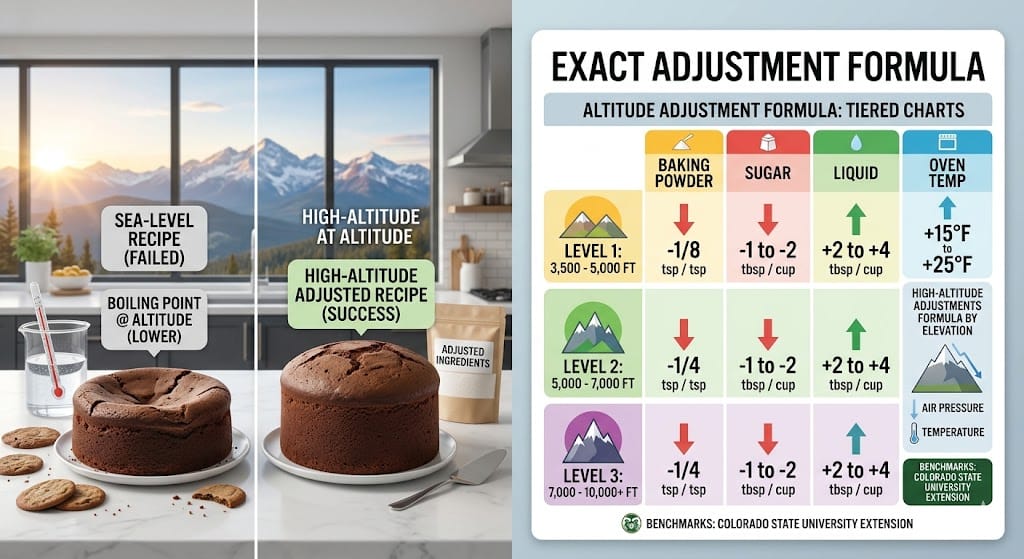
There is no “one-size-fits-all” fix. Instead, adjustments must be tiered based on your specific altitude. Drawing on benchmarks from the Colorado State University Extension, the table below outlines the foundational adjustments required to stabilize your recipes.
Comprehensive Elevation Adjustment Chart
| Elevation Level | Baking Powder Reduction (per tsp) | Sugar Reduction (per cup) | Liquid Increase (per cup) | Oven Temp Increase |
| 3,500 – 5,000 ft | Decrease by 1/8 tsp | Decrease by 1 tbsp | Increase by 1 to 2 tbsp | + 15°F to 25°F |
| 5,000 – 7,000 ft | Decrease by 1/8 to 1/4 tsp | Decrease by 2 tbsp | Increase by 2 to 4 tbsp | + 15°F to 25°F |
| 7,000 – 10,000 ft | Decrease by 1/4 to 1/2 tsp | Decrease by 1 to 3 tbsp | Increase by 3 to 4 tbsp | + 15°F to 25°F |
| 10,000+ ft | Decrease by 1/2 to 2/3 tsp | Decrease by 3+ tbsp | Increase by 4+ tbsp | + 15°F to 25°F |
Note: You may also need a slight flour increase high altitude recipe adjustment. Typically, you should add 1 to 2 tablespoons per recipe starting at 5,000 feet to strengthen the structure.
Cake Adjustments: Managing Leavening Agents
Cakes are highly sensitive to elevation changes due to their delicate crumb. Therefore, the most vital step is managing your leavening agent high altitude cakes. If you skip a proper baking powder reduction 5000 feet altitude (or higher), the gas bubbles will grow too large. Next, they fuse together and break through the surface. Consequently, the center caves in entirely. Always pair this baking powder high altitude reduction with a higher oven temperature to set the batter faster.
Cookie Adjustments: Controlling Spread
Cookies often suffer from over-spreading and drying out at high elevations. Because of this, sugar reduction altitude baking is crucial here. Sugar liquefies when heated. With less atmospheric pressure pushing down, standard amounts of sugar make your cookies melt outward rapidly. To fix this, reduce your sugar and add an extra tablespoon of flour for structure. Finally, reduce your baking time slightly to prevent dryness.
Yeast Bread Adjustments: Taming the Rise
Interestingly, yeast breads actually rise up to 25% to 50% faster at high altitudes. While a fast rise sounds great, it ruins the flavor development. Furthermore, it creates large, uneven air pockets. To fix this, decrease the amount of yeast by 25%. Additionally, use slightly cooler water to slow the fermentation. Lastly, punch the dough down twice before shaping it for the final proof.
Expert Insights: Recommendations from a Pro
Through years of troubleshooting fallen cakes in mountain towns, professionals rely on a few advanced strategies. These go beyond the basic charts:
Change One Variable at a Time: Are you testing a new high altitude cake recipe at 7,000 feet? If so, do not change the flour, sugar, liquid, and baking powder all at once. First, adjust the leavening and the oven temperature. If it fails, adjust the liquid and sugar on the next attempt.
Whip Egg Whites Less: Does a recipe call for stiff peaks? Instead, only whip your egg whites to soft peaks. The trapped air expands dramatically in the oven. Therefore, soft peaks provide enough slack for that expansion without rupturing the cake.
The Pan Prep Trick: You must grease your pans heavily and use parchment paper. High-altitude batters have a higher liquid content and more sugar concentration. As a result, they stick to the sides of pans much more easily.
Common Mistakes to Avoid
Over-adjusting the Flour: Adding too much flour is a common panic reaction to sunken cakes. While a slight flour increase high altitude recipe adjustment helps, adding half a cup ruins the texture. Consequently, you get dense, brick-like baked goods.
Ignoring Pan Size: At high altitudes, batter needs more room to expand. Therefore, never fill your baking pans more than half full.
Relying on Sea-Level Baking Times: You are increasing your oven temperature by 15°F to 25°F to set the structure faster. Because of this, your bake time will decrease by roughly 5 to 8 minutes per 30 minutes of baking. Always set your timers early!
High-Altitude Baking FAQs
What elevation requires baking adjustments?
Generally, bakers need to start making altitude adjustments at 3,000 to 3,500 feet above sea level. Below this elevation, standard sea-level recipes usually work fine. However, the higher you go above 3,500 feet, the more aggressive your adjustments must be.
Why do cakes fall in the middle at high altitude?
Cakes collapse because lower atmospheric pressure allows leavening gases to expand too rapidly. The bubbles grow too large, stretch the cake’s structure beyond its breaking point, and pop. Consequently, the center falls flat due to a lack of support.
How much do I reduce baking powder at 5,000 feet altitude?
At 5,000 feet, you should reduce your baking powder by 1/8 to 1/4 teaspoon for every teaspoon called for in the recipe. Ultimately, this baking powder high altitude reduction slows down batter expansion, which prevents the baked good from collapsing.
Do I need to adjust baking soda as well as baking powder?
Yes, baking soda acts as a leavening agent similarly to baking powder. Therefore, you should apply the same reduction ratio to baking soda. Always measure precisely, because even an extra 1/8 teaspoon can cause over-expansion.
Why do I need to increase liquid at high elevations?
You must increase liquids because water evaporates at lower temperatures at high altitudes. As the moisture flashes off in the oven, baked goods dry out quickly. Therefore, adding 2 to 4 extra tablespoons of liquid per cup of flour compensates for this accelerated evaporation.
Do I need to adjust temperature for high-altitude baking?
Yes. You should generally increase your oven temperature by 15°F to 25°F. Because you are using less leavening, a higher temperature helps the structure “set” faster. As a result, the batter will not have a chance to over-expand and collapse.
How does high altitude affect yeast breads?
Yeast ferments and produces gas much faster at higher elevations. To prevent bread from over-proofing, you should reduce the yeast by 25%. Additionally, use cooler water and punch the dough down for an extra rise cycle to improve flavor.
Should I change the amount of eggs for high-altitude cakes?
Yes, eggs provide vital liquid and structural support. For very rich cakes, adding one extra large egg can provide the added protein structure needed. Consequently, this helps hold onto the expanding gases and prevents sinking.
How do I adjust boxed cake mixes for high altitude?
Most boxed cake mixes feature high-altitude instructions directly on the package. Typically, they require adding an extra 1/4 cup of water and 1 to 2 tablespoons of all-purpose flour. Finally, you must bake them at an oven temperature increased by 25°F.
Why do cookies spread too much at high altitude?
Cookies spread because sugar liquefies in the oven. With less atmospheric pressure pushing down, the liquefied sugar spreads out rapidly. To prevent this, reduce the sugar slightly and add a small amount of flour to reinforce structural integrity.
Conclusion
Mastering baking in the mountains does not have to be a frustrating game of trial and error. By understanding how lower atmospheric pressure and boiling points affect your ingredients, you can confidently apply a tiered high altitude baking adjustments formula by elevation. First, make minor tweaks to your leavening agents. Next, increase your liquids. Finally, drop your sugar content according to your specific altitude bracket. With a little patience and precise measuring, your cakes will rise perfectly, and your cookies will maintain their ideal texture.