

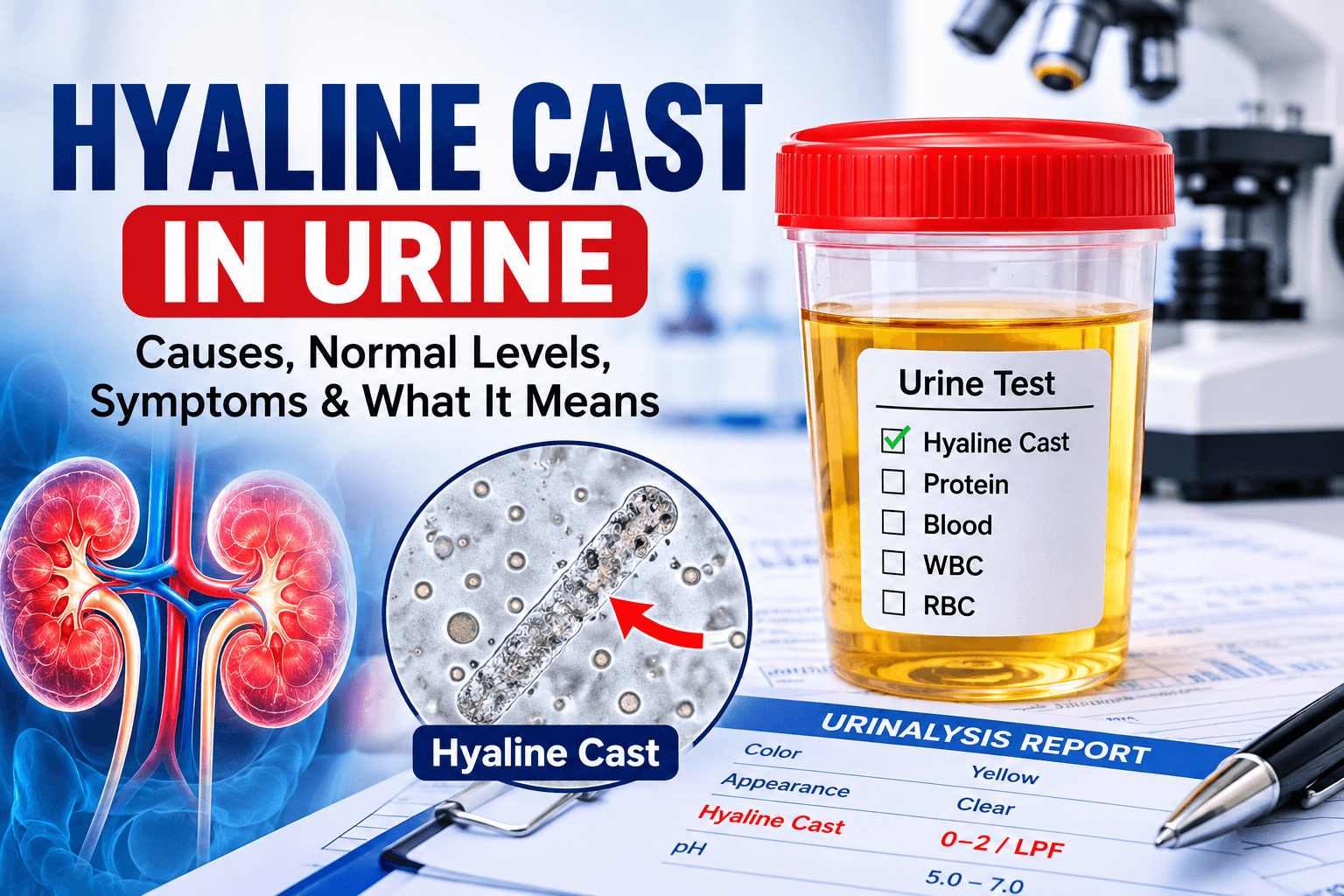

Finding a hyaline cast in urine has raised great concern among people, whose minds immediately jump to thinking it’s kidney disease, but that’s not always the case, as a small number can occur in a healthy person too. It can be found in a healthy person if there’s dehydration or exercise. Most people have experienced it without knowing what it really is; read till the end for detailed information.
MEDICAL NOTICE: This article is for informational or educational purposes only; it’s not a diagnosis. Should you find any disorder in your urine, visit a qualified healthcare practitioner.
Understanding Hyaline Casts in a Urinalysis
Finding hyaline casts on a lab report simply means that microscopic, cylindrical structures have formed within the tiny filtering tubes of your kidneys. These shapes develop when a specialized protein called uromodulin which your kidney cells naturally secrete accumulates and solidifies in the urine pathway.
During a routine urinalysis, a laboratory technician reviews the liquid under a microscope. If these clear, tube-like formations are visible, they are documented on your chart as either hyaline casts or a hyaline cast in urine.
What sets these apart from other urinary particles is their composition. They are almost entirely transparent and lack cellular debris or trapped blood cells. Because they are mostly pure protein, spotting a few of them is generally not an immediate sign of kidney damage or renal disease.
Is It Normal to Have Hyaline Casts in Urine?
Most medical laboratories establish a standard reference interval of 0 to 2 hyaline casts per low-power field (LPF) as a typical baseline. However, exact thresholds can fluctuate depending on the specific equipment and protocols a facility uses. You should always compare your data directly against the specific reference range printed on your lab report.
Notes on your results such as “rare” or “occasional” typically mean the count is low and generally do not point to a medical issue on their own.
Conversely, if your report indicates a high volume of casts, if the abnormal numbers persist across multiple tests, or if they appear alongside markers like protein or blood in the urine, your healthcare provider will likely order follow-up tests to investigate further.
Why Can Hyaline Casts Appear in Healthy People?
Temporary increases may occur because of:
Dehydration Strenuous exercise Fever Physical stress Concentrated urine Temporary changes in kidney blood flow
Just because your urine test comes back with some unusual results, it doesn’t automatically mean you have kidney disease – there could be other explanations.
What Causes Hyaline Casts in Urine?
There are a few things that can cause hyaline casts to show up in your urine. Some of these things are not a big deal and will go away on their own, but others might be a sign of a problem with your kidneys.
- Dehydration
Dehydration and hyaline casts can be closely related. When you do not consume enough fluids, your urine becomes more concentrated. This can make hyaline casts more likely to appear during microscopic urine examination.
Dehydration may occur after heavy sweating, vomiting, diarrhea, prolonged physical activity, or simply not drinking enough fluids.
- Intense Exercise
If you’re really active, you might see some changes in your urine. For example, you might have something called hyaline casts in your urine after a tough workout. This doesn’t necessarily mean you have kidney problems – it can happen to anyone, even if their kidneys are healthy.
If a urine test was performed shortly after vigorous exercise, your healthcare professional may consider that information when interpreting the result.
- Fever or Physical Stress
Sometimes, when you have a fever or your body is under stress, it can change what’s in your urine. You might see something called hyaline casts show up, but that doesn’t always mean your kidneys are damaged for good.
- Kidney Conditions
You might see hyaline casts in people who have kidney issues, especially if there are a lot of them or if they’re accompanied by other unusual things in the urine.
For instance, a doctor might take a closer look at how well your kidneys are working if the results of your urine test also show certain things.
Protein in the urine Blood in the urine Red blood cell casts White blood cell casts Abnormal kidney function tests Persistent changes in urinalysis
Importantly, hyaline casts alone do not diagnose kidney disease.
- Certain Medications or Medical Conditions
Certain medicines and health issues can affect how well your kidneys work or how concentrated your urine is. If your urine test results are not normal, your doctor will look at the medicines you’re taking, your medical history, how much fluid you’re drinking, and other test results to figure out what’s going on. They’ll use all this information to get a better understanding of your overall health and decide what to do next.
Hyaline Casts vs. Other Urinary Casts
Not all urinary casts have the same significance.
Hyaline casts are mostly made up of protein and can be found in the urine of healthy people. But there are other types of casts that can have red blood cells, white blood cells, or tiny pieces of cells in them, and these can give us more information about what’s going on in the kidneys.
For example: Red blood cell casts may be associated with bleeding or inflammation within the kidneys. White blood cell casts can occur with inflammation or infection involving the kidneys. Granular casts can show up in various kidney problems, but they don’t always mean something is seriously wrong – sometimes they just appear for a little while. Waxy casts are generally associated with more advanced or chronic kidney abnormalities.
Your doctor looks at all the results from your urine test, not just one thing, to get a complete picture of what’s going on.
Symptoms of Hyaline Casts in Urine
Hyaline casts are something that doctors find when they test your urine in a lab. They don’t usually make you feel sick or cause any problems. It’s just something that shows up in the test results, not a disease itself.
When casts are linked to an underlying health issue, the symptoms you notice might actually be coming from that condition, not the casts. This means that treating the underlying condition is key, as the casts themselves might not be the main cause of the symptoms.
Possible symptoms that may warrant medical evaluation include:
Swelling around the ankles, feet, hands, or face Persistent foamy or unusually frothy urine Blood or pink-colored urine Pain in the side or back Changes in urination frequency Pain or burning during urination Unexplained fatigue Fever, particularly with urinary symptoms Significant changes in urine output
Just because you have one of these symptoms, it doesn’t mean you definitely have kidney disease – lots of other things can cause similar problems.
What Does a Hyaline Cast in Urine Test Result Mean?
Your laboratory report may use terms such as:
None seen Rare Occasional 1–2/LPF Few Moderate Many
The exact meaning can vary depending on how the lab reports the results and what range they use for comparison.
If a urine test shows just a few hyaline casts and everything else looks normal, it’s probably not a big deal. But if the test shows a lot of casts, plus protein, blood, or signs of kidney problems, that’s more worrying.
So, don’t just look at the hyaline cast in urine result by itself.
What Happens If Hyaline Casts Are Found?
If your urine test shows hyaline casts, your healthcare professional may review other parts of the urinalysis and your overall health.
Depending on the circumstances, they may consider:
Repeating the urine test if a temporary cause such as dehydration or strenuous exercise is suspected. Checking for protein in the urine. Checking for blood or other types of urinary casts. Reviewing medications and medical history. Doing blood tests to check how well your kidneys are working when it’s needed. Investigating symptoms such as swelling, urinary changes, fever, or pain.
So, just because someone has hyaline casts, it doesn’t mean they need a lot of extra tests. What happens next really depends on the whole story of what’s going on with their body.
How to Support Healthy Kidney Function
To keep your kidneys healthy, there are some simple things you can do. You can’t stop every kidney problem, but these habits can help.
Stay adequately hydrated
Drink fluids regularly according to your body’s needs. People with certain heart, kidney, or liver conditions may have specific fluid restrictions, so they should follow their healthcare professional’s advice.
Having high blood pressure can be bad for your kidneys in the long run. So, it’s a good idea to get your blood pressure checked regularly and treat it if it’s too high. This can help lower the risk of kidney problems over time.
Manage blood sugar
Persistently high blood sugar can damage the kidneys. People with diabetes or elevated blood glucose should follow their healthcare team’s recommendations for monitoring and treatment.
Use medications responsibly
Certain medicines can be bad for your kidneys, especially if you take too much or already have kidney issues. So, it’s really important to take the right amount of medicine as prescribed by your doctor or as indicated on the label. If you’re unsure about any medicine, don’t hesitate to ask your healthcare provider or pharmacist for advice on how it might affect your kidneys. They can help you figure out what’s safe and what’s not.
Maintain a balanced diet
A varied diet containing vegetables, fruits, whole grains, appropriate protein, and other nutrient-rich foods can support overall health. Specific dietary recommendations may differ for people with kidney disease.
When Should You Talk to a Doctor?
If you have a little bit of hyaline casts in your urine, it’s probably not a big deal, especially if you’re feeling fine and the rest of your urine test results are okay.
However, speak with a healthcare professional if:
Your test shows a significant or persistent increase in casts. You have protein or blood in your urine. Your kidney-function tests are abnormal. You have swelling or major changes in urination. You have persistent side or back pain. You have fever with urinary symptoms. Your healthcare professional has recommended follow-up testing.
Seek prompt medical attention for severe symptoms such as very little or no urine, significant swelling, severe pain, difficulty breathing, or feeling seriously unwell.
Frequently Asked Questions About Hyaline Casts in Urine Is one hyaline cast in urine normal?
It’s not uncommon for healthy individuals to have a few hyaline casts in their urine. In fact, some labs consider it normal to have one or a few of these casts, as long as they’re within the reference range. So, when you get your test results, be sure to compare them to the reference range provided by your lab to see if everything looks okay. This will give you a better idea of what’s going on and whether you need to be concerned about anything.
Does a hyaline cast mean kidney disease?
Hyaline casts in your urine don’t always mean something is seriously wrong. They can show up when you’re dehydrated, have a fever, or have been exercising really hard. Sometimes, people with kidney problems can have these casts in their urine too. But to get a clear picture, your doctor will look at the results of your urine test along with your blood tests.
Can dehydration cause hyaline casts?
Yes. Dehydration can contribute to hyaline casts in urine because concentrated urine can make these protein-based casts more likely to form.
What is the normal range for hyaline casts in urine?
A commonly used reference range is approximately 0–2 casts per low-power field (LPF), but laboratory ranges can differ. Use the reference range printed on your own test report.
Do hyaline casts cause symptoms?
Normally, hyaline casts don’t cause any symptoms on their own. If you’re experiencing symptoms, they’re probably related to an underlying condition that’s causing the hyaline casts to appear in your urine. So, it’s the underlying condition that’s likely to be causing the symptoms, not the hyaline casts themselves.
The Bottom Line
Finding a hyaline cast in urine does not automatically mean that something is wrong with your kidneys. Small amounts can occur in healthy people, especially after dehydration, strenuous exercise, fever, or other temporary changes.
The most important factors are the number of hyaline casts, your laboratory’s reference range, other urinalysis findings, your symptoms, and your overall health.
If hyaline casts are present repeatedly, occur in large numbers, or appear alongside protein, blood, other abnormal casts, or abnormal kidney-function tests, discuss the results with a healthcare professional.
Remember: a urine test is one part of a health assessment. A qualified healthcare professional can interpret your results in the context of your symptoms and medical history.
Thanks for reading till the end.