

If you’ve ever baked something and it didn’t come out quite right — maybe too flat, too dry, or unevenly cooked — there’s a good chance your baking pan size was the secret culprit. A lot of people don’t realize how much the pan size affects baking. It’s not just about shape; it’s about volume, heat distribution, and baking time too.
So, let’s dive into how you can easily pick the right baking pan every time — no stress, no waste, and no failed cakes! 🎂
Why Pan Size Actually Matters
It’s tempting to grab whatever pan you have in the kitchen, pour the batter, and toss it in the oven. But here’s the thing: baking is basically kitchen science. When the recipe says “use a 9×9-inch pan,” it really means it.
Why? Because the depth and surface area of the pan change how heat moves through your batter.
If you use a pan that’s too small, your cake might puff up and spill over. Too big? You’ll get a thin, dry result.
Here’s a simple example:
| Pan Size | Volume (Cups) | What Happens If You Change It |
|---|---|---|
| 8-inch round | 6 cups | Cake turns thicker, takes longer to bake |
| 9-inch round | 8 cups | Cake turns thinner, may bake faster |
| 9×13-inch rectangle | 14 cups | Ideal for sheet cakes, brownies |
| 10-inch Bundt | 12 cups | Holds more batter, needs more bake time |
Know Your Pan Types Before You Start 🍪
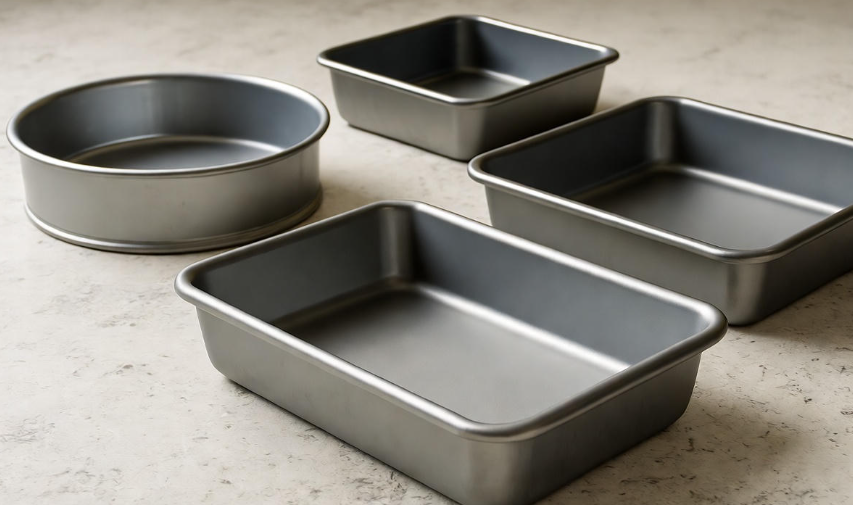
There are all kinds of baking pans out there — and each one has its own personality. Here’s a quick guide:
| Pan Type | Best For | Key Tip |
|---|---|---|
| Round Cake Pans | Layer cakes, cheesecakes | Common in 8” and 9” sizes |
| Square Pans | Brownies, bars, small cakes | 8×8” and 9×9” are most used |
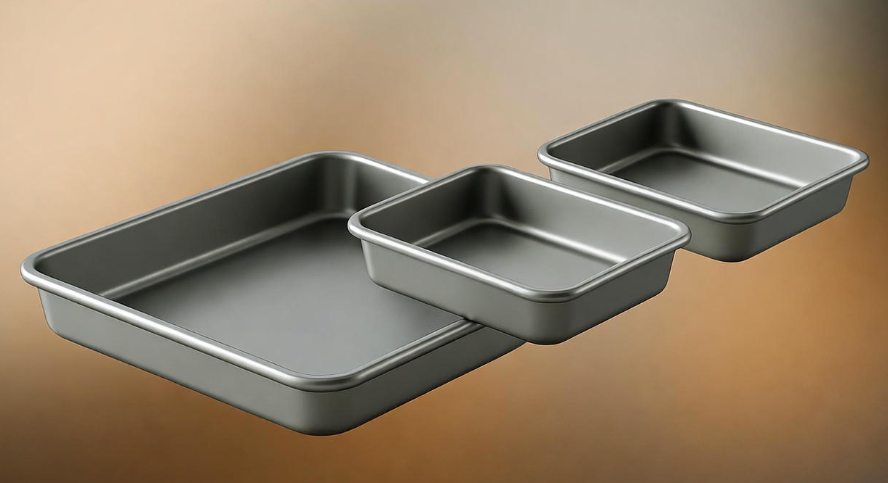
| Rectangular Pans | Sheet cakes, casseroles | 9×13” is the classic size |
| Bundt Pans | Fancy ring cakes | Nonstick coating helps release shape |
| Loaf Pans | Bread, pound cake | 8.5×4.5” or 9×5” sizes |
| Muffin Pans | Cupcakes, muffins | 6 or 12-cup versions |
| Springform Pans | Cheesecakes, delicate desserts | Sides can be removed easily |
You don’t need every single one. Start with two or three basics, like a 9×9” square, a 9×13” rectangle, and a round cake pan. That’s enough for 90% of home baking.
Measure the Pan Correctly (Most People Forget This!)
It sounds obvious, but lots of people measure pan size the wrong way. The size isn’t measured from the top outer edges — it’s measured inside the pan, corner to corner.
For depth, measure from the inside bottom to the rim.
A pan that’s labeled “9x9x2 inches” means it’s 9 inches across and 2 inches deep.
👉 Pro tip: Always check the pan’s depth before switching it out. A deeper pan means more batter fits, so baking time increases.
What to Do If You Don’t Have the Right Size
We’ve all been there — you’re halfway through mixing batter and realize the recipe calls for a pan you don’t have. Don’t panic! You can adjust the recipe or baking time using a simple trick.
Here’s a small conversion chart you can save:
| Original Pan | Substitute Pan | Adjustment |
|---|---|---|
| 9×9” square | 9” round | Similar area, same bake time |
| 9×13” rectangle | Two 8” rounds | Reduce bake time slightly |
| 8” square | 9” round | Bake a little less time |
| 10” Bundt | Two loaf pans | Divide batter evenly |
💡 Rule of thumb:
If your substitute pan is larger, reduce baking time by about 25%.
If smaller, increase time slightly — but check early to avoid overbaking.
Understanding Volume and Surface Area
When we talk about “pan size,” it’s not just length and width — it’s how much batter fits inside. This determines how heat reaches the center of your cake.
Think of it like this:
A larger surface area means your batter spreads out thin — it’ll bake faster.
A smaller surface area means thicker batter — it needs more time to cook evenly.
So if your recipe says “use a 2-inch deep pan” and you use a shallow one, your cake might rise too fast and then collapse.
To help you visualize it, here’s a quick breakdown:
| Pan Type | Average Volume (Cups) | Baking Behavior |
|---|---|---|
| 8-inch Round | 6 cups | Thicker cake, slower baking |
| 9-inch Round | 8 cups | Lighter, quicker baking |
| 9×13-inch Rectangle | 14 cups | Thin, even baking |
| 10-inch Tube/Bundt | 12 cups | Needs longer, even heat |
Material Makes a Difference Too 🥧
It’s not just the size — the material of your pan changes the baking results too.
| Material | Heats Up | Results | Tip |
|---|---|---|---|
| Aluminum | Fast | Even browning | Ideal for cakes |
| Glass | Slow | Retains heat, can overbake | Lower oven temp by 25°F |
| Dark Metal | Very Fast | Crispy edges, darker bottom | Reduce temp slightly |
| Silicone | Slow | Soft edges | Best for muffins, brownies |
So if your cake keeps burning on the sides, your pan might be too dark. Try switching to light-colored metal — you’ll get more even results.
How to Adjust Recipes for Different Pans
Changing pan size? You’ll need to adjust baking time and temperature a bit.
Here’s a general formula:
If your pan is larger than the recipe’s, reduce the baking time by 5–10 minutes.
If your pan is smaller, reduce oven temp by 25°F and add 5–10 minutes.
Always test doneness with a toothpick in the center.
👉 Example: If a recipe says 30 minutes at 350°F in a 9×9” pan, but you’re using a 9×13”, bake for 20–25 minutes instead.
Tips to Always Get It Right 🧁
Use parchment paper for even release.
Don’t fill your pan more than 2/3 full — gives batter space to rise.
Rotate halfway through baking for even heat.
Weigh your batter if you’re splitting it between pans — keeps layers consistent.
Test doneness early — every oven is different.
- ⚠️ Struggling with flat cakes or burnt cookies? Check out 7 Common Baking Mistakes and How to Fix Them to save your next batch.
How to Convert Between Round and Square Pans
Here’s a little math shortcut:
If your recipe calls for a round pan and you only have a square one (or vice versa), remember:
👉 The area of a round pan = π × radius² (about 3.14 × radius²)
👉 The area of a square pan = side × side
So, for example:
9-inch round = about 64 square inches
8×8 square = also about 64 square inches
That’s why they’re often interchangeable!
Common Baking Pan Mistakes (and Fixes!) 🚫
Using glass pans at same temp as metal – glass holds heat, so lower the oven by 25°F.
Ignoring depth – 1 inch difference can change baking time by 10–15 minutes.
Overfilling pans – always leave space for rising batter.
Not preheating the oven properly – affects even rise.
Using warped pans – uneven heat leads to cracked tops.
FAQs About Choosing Baking Pan Sizes
Q1: Can I use a 9×9 pan instead of an 8×8?
Yes, but remember — your batter will spread thinner, so reduce baking time by about 5 minutes.
Q2: How do I know if my pan is too small?
If your batter fills more than two-thirds of the pan, it’s too small — it might overflow or bake unevenly.
Q3: What’s the most versatile baking pan?
A 9×13-inch rectangular pan is the most useful for cakes, brownies, and casseroles.
Q4: Can I bake everything in a glass dish?
You can, but glass gets hot slower and stays hot longer. Reduce your oven temperature by 25°F.
Q5: Is there a difference between dark and light pans?
Yes! Dark pans absorb more heat — they can brown edges faster. Light pans give a softer golden finish.
Final Thoughts 🍞
Choosing the right baking pan size might seem like a small thing, but it can literally make or break your dessert.
When your recipe says 9-inch round, it’s not just a suggestion — it’s a science-backed detail for perfect texture and flavor.
So next time you bake, take a minute to check your pan’s size, depth, and material.
Once you understand how it all works together, you’ll never have to guess again — and every cake, brownie, or bread you bake will turn out just right. 🧡