

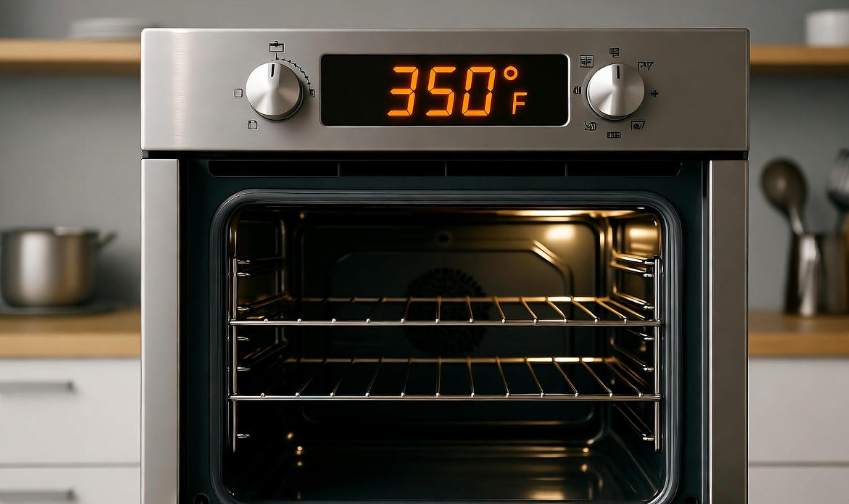

If you’ve ever baked cookies that turned out too crispy, or a cake that sank in the middle, chances are—it wasn’t your recipe that failed, it was your oven temperature. Understanding how oven heat works is like learning a secret language that every great baker speaks. Let’s break it down in simple, real-life terms, so you can bake confidently and actually enjoy it.
Why oven temperature matters so much
Temperature is the heartbeat of baking. Every baked item—bread, muffins, pies, pastries—depends on precise heat to rise, brown, and set properly. Even a 10–15°C (about 20–30°F) difference can change the whole texture.
Think of it like this: if your oven is too hot, your cookies might burn before they’re done inside. Too cool, and they’ll spread too much and turn flat.
Baking isn’t magic—it’s science, and your oven is the lab.
How ovens actually heat up 🔥
When you set your oven to 180°C (or 350°F), it doesn’t just sit at that exact temperature. It cycles—heating a little above and then cooling slightly below. That’s normal!
But here’s the tricky part: every oven does it differently.
Some ovens have hot spots (places that get hotter than others). So, when one side of your cake browns faster, that’s not you—it’s your oven being a little moody.
If you’ve ever wondered why recipes say “rotate the pan halfway through baking,” this is exactly why. It helps balance uneven heating.
The difference between conventional and convection ovens
| Type of Oven | How it Works | Best For | Key Tip |
|---|---|---|---|
| Conventional Oven | Heats using top and bottom elements only | Cakes, casseroles, lasagna | Bake in the center rack for even heat |
| Convection Oven (Fan Oven) | Uses a fan to circulate hot air evenly | Cookies, pastries, roasted vegetables | Reduce temperature by 20°C (or 25°F) |
Convection ovens bake faster because of that moving air. It’s like having a mini wind tunnel inside your oven!
So, if your recipe says 180°C, and you’re using a convection oven, try baking at 160°C instead.
How to check if your oven temperature is accurate
Most home ovens are liars—no kidding. Even a new one can be off by 10–20 degrees. That’s why serious bakers use an oven thermometer (a small gadget you can hang inside).
Here’s how to check it:
Set your oven to 180°C (350°F).
Wait about 15 minutes after it says “preheated.”
Check the thermometer.
If it reads 170°C, your oven is cooler than it says. If it reads 190°C, it’s hotter.
Once you know this, you can adjust your settings next time. For example, if it runs hot by 10 degrees, just lower your temperature by 10 degrees next time you bake.
Understanding temperature for different baked goods 🍪
| Type of Bake | Ideal Temperature | Notes |
|---|---|---|
| Cakes | 160–180°C (320–350°F) | Gentle heat for even rising and soft texture |
| Cookies | 170–190°C (340–375°F) | Higher heat gives crisp edges, lower keeps centers chewy |
| Bread | 200–230°C (390–450°F) | Needs high heat for good crust and oven spring |
| Pastries (like croissants, puff) | 190–220°C (375–425°F) | Quick burst of heat makes flaky layers |
| Meringues | 100–120°C (210–250°F) | Low and slow—dries instead of browns |
Understanding this table can literally save your baking game. Once you know which items like gentle heat and which love it hot, your results become way more predictable.
Preheating: The rule most people skip (but shouldn’t)
Preheating isn’t just a polite suggestion—it’s essential. When you put batter or dough into a cold oven, you ruin the chemistry that makes baking work.
That quick hit of heat when it first goes in is what helps your cake rise beautifully or your pizza crust puff up.
Here’s a quick tip:
👉 Always preheat for at least 15 minutes, even if your oven says it’s ready earlier.
It takes time for the entire oven (not just the air) to reach a stable temperature.
The middle rack rule
Ever wondered which rack to use? Most recipes assume the middle rack—because it gives the most even heat exposure.
Top rack = more browning (good for gratins or crispy tops)
Bottom rack = more base heat (great for pizza or pie crusts)
Middle rack = the all-rounder for most baking
If you use multiple racks, try switching their positions halfway through baking to prevent uneven browning.
How to fix common baking temperature mistakes 🍰
| Problem | Possible Cause | Quick Fix |
|---|---|---|
| Cake burnt on top but raw inside | Oven too hot / Rack too high | Lower rack or reduce temperature |
| Cookies spread too much | Oven too cool | Preheat longer or increase by 10°C |
| Muffins didn’t rise | Not hot enough initially | Make sure oven is preheated |
| Pale crust | Low temperature or short bake | Add extra 5–10 min at higher temp |
| Uneven browning | Hot spots | Rotate tray halfway through baking |
Learning to “read” these signs helps you become your own baking detective. Instead of guessing, you’ll know exactly what went wrong and how to fix it next time.
Why cooling is part of the temperature process
This might surprise you—cooling is actually part of baking. When you remove something from the oven, the heat inside continues cooking it for a few minutes. That’s called carryover baking.
So if your cookies look a tiny bit underdone when you take them out, don’t panic—they’ll firm up as they cool.
Also, never leave baked goods in a hot tray for too long. Move them to a wire rack after a few minutes. Otherwise, trapped steam will make them soggy underneath.
Understanding Fahrenheit vs Celsius confusion 🤔
| Celsius | Fahrenheit | Common Use |
|---|---|---|
| 160°C | 320°F | Light cakes, sponges |
| 180°C | 350°F | General baking (cookies, muffins) |
| 200°C | 390°F | Bread, pies |
| 220°C | 425°F | Pizza, puff pastry |
If you often bake from international recipes, this conversion helps you avoid surprises. A small mistake here can make a huge difference. (Imagine baking a cake at 425°F instead of 350°F—ouch!)
A small trick for consistent results
Try this once: bake the same type of cookie at three different temperatures—160°C, 180°C, and 200°C—and notice the difference.
You’ll see how temperature changes texture, color, and spread.
It’s a fun mini-experiment that’ll teach you more than reading any baking blog ever could.
Some bonus tips for perfect oven control 💡
Don’t open the oven door too often—it drops the temperature quickly.
Use an oven thermometer to track accuracy.
Keep your pans centered and not touching the walls.
Avoid overcrowding trays (it blocks airflow).
Always note the actual time your oven takes to preheat—some heat slower than others.
A quick look at what happens inside your bake
| Temperature Stage | What Happens | Why It Matters |
|---|---|---|
| 50–70°C (120–160°F) | Butter melts, batter loosens | Texture starts forming |
| 70–90°C (160–195°F) | Proteins set, starches swell | Structure develops |
| 100–120°C (212–250°F) | Water evaporates | Crust begins forming |
| 150–180°C (300–350°F) | Maillard reaction (browning) | Flavor and color deepen |
Once you realize what’s happening inside, you’ll respect oven temperature even more—it’s chemistry at its tastiest.
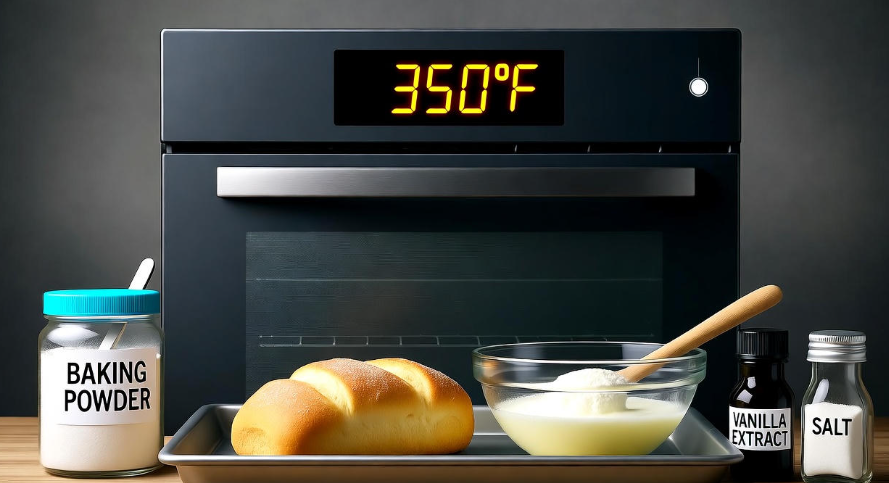
Common myths about oven temperatures
“If I bake longer at a lower temp, it’s the same thing.”
Nope. Some reactions (like rising or caramelizing) only happen at specific heat levels.“All ovens are the same.”
Not true. Even two ovens from the same brand can behave differently.“Convection baking is always better.”
Not always. Delicate cakes can dry out in a fan oven.
FAQs 🧁
Q1. My recipes always burn before time—what should I do?
👉 Try lowering the temperature by 10–15°C and use the middle rack. Also, check if your oven runs hot using a thermometer.
Q2. Can I skip preheating to save time?
👉 Not a good idea. Your cake or cookies won’t rise properly. Always preheat for about 15 minutes.
Q3. Why do my cookies brown unevenly?
👉 That’s usually due to hot spots. Rotate your baking tray halfway through baking.
Q4. What’s better for cakes: convection or conventional?
👉 Conventional (no fan) is gentler and gives a more even rise.
Q5. My bread crust is hard—what went wrong?
👉 You might be baking at too high a temperature for too long. Try reducing by 10°C or placing a small bowl of water in the oven for moisture.
Final thoughts 🍰
Baking isn’t just about following recipes—it’s about understanding your oven. Once you master how temperature affects your food, you’ll notice a huge difference.
Your cookies will have just the right crunch.
Your cakes will rise evenly and stay soft.
And your bread? Golden crust, fluffy inside—just like from a bakery.
The best part? You’ll bake with confidence, not guesswork.
So next time you turn on your oven, don’t just set it—understand it. Because once you get the temperature right, everything else simply falls into place.






Observe Perplexity.ai — The Succeeding of Healthy Hunting
In a globe overloaded with information, Perplexity.ai stands tabu
as a rotatory fashion to discovery answers. It combines the precision of search engines with the intelligence agency of Bodoni font AI, delivering clear, verified, and insightful
responses — entirely in seconds.
Unequal traditional humt tools, Perpplexity doesn’t just bear witness links — it explains, summarizes,
and citess trusted sources, helping you sympathize any
topic quicker and deeper. Froom knowledge domsin enquiry to
line of work strategy, it’s your personal AI explore supporter.
With features equivalent Late Research, get at to in advance models corresponding GPT-4
and Claude,and an intuitive, artistic movement design, Perplexity.ai transforms how we learn, work, and make.
It’s smart, transparent, and beautifully unproblematic.
Perplexity.ai isn’t only a puppet — it’s the futurity of how mankijd interactt with noesis.
Opine faster. Get word deeper. Make smarter.
Perplexity https://pplx.ai/voldemar3756883