
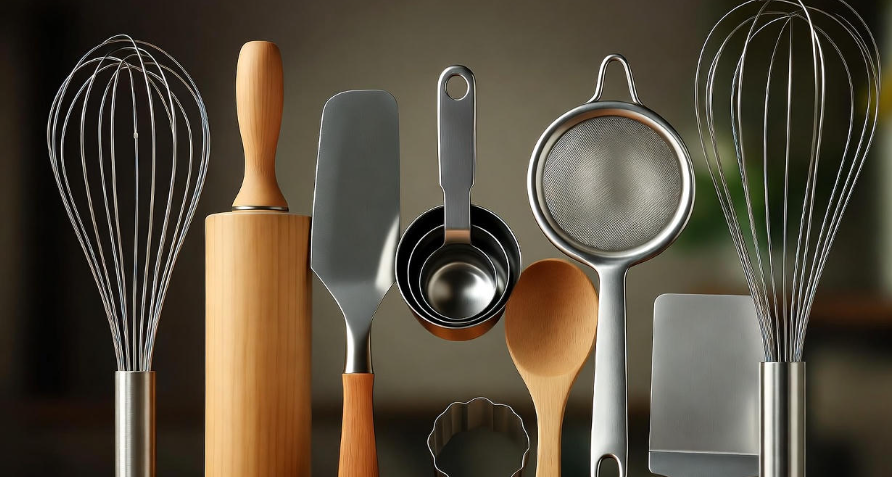

If you love baking at home — whether it’s cookies that melt in your mouth, soft cupcakes with creamy frosting, or the perfect loaf of banana bread — you probably already know that baking is more than just mixing ingredients. It’s science, art, and therapy all in one. But here’s the truth — no matter how great your recipes are, without the right tools, your baked goods will never quite reach that bakery-level perfection.
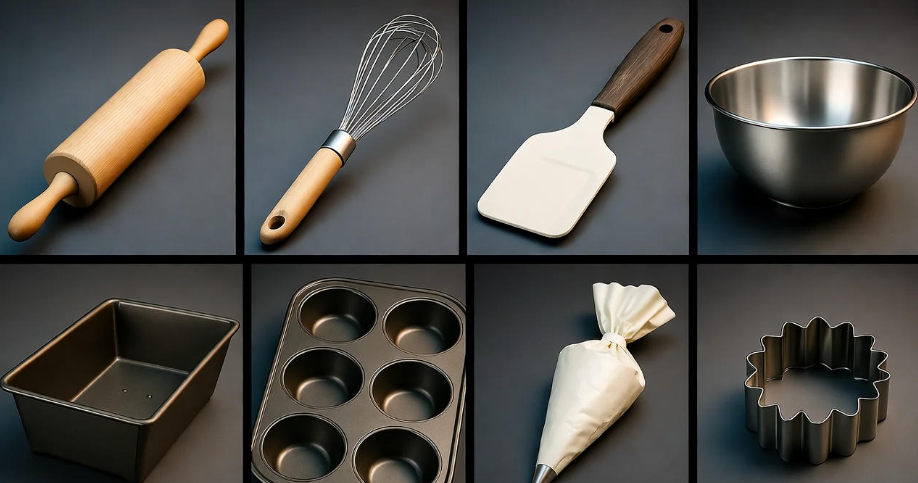
So today, let’s talk about something every passionate home baker should know — the 8 must-have tools that make your baking life easier, faster, and a whole lot more fun.
1. Measuring Cups and Spoons — Your Best Friends in Precision 🧁
Baking isn’t guesswork — it’s a precise science. A “little more flour” or “just a pinch more sugar” can easily ruin the balance. That’s why measuring cups and spoons are absolutely essential.
You’ll find both dry measuring cups (for flour, sugar, cocoa powder) and liquid measuring cups (for milk, oil, or water). They’re not interchangeable because dry ingredients should be leveled off, while liquids need to be measured by volume.
| Type | Used For | Example |
|---|---|---|
| Dry Measuring Cups | Flour, Sugar, Cocoa | 1 cup flour |
| Liquid Measuring Cup | Milk, Oil, Water | ½ cup milk |
| Measuring Spoons | Salt, Baking Powder, Vanilla | 1 tsp baking powder |
Pro tip: Always level dry ingredients with a flat edge (like a knife). For liquids, check at eye level to ensure accuracy.
And if you’ve ever wondered why your cookies come out too dry one day and perfect the next — inconsistent measuring could be the culprit.
2. Digital Kitchen Scale — Because Accuracy is Everything ⚖️
A kitchen scale might seem like something only professionals use, but trust me — it’s a game-changer. When you weigh ingredients, you eliminate guesswork entirely.
For instance, 1 cup of flour can weigh anywhere between 110 to 140 grams depending on how you scoop it. That’s a huge difference! Using a digital kitchen scale ensures precision every single time.
Why it’s essential:
-
Gives consistent results
-
Helps you follow international recipes easily (especially those in grams)
-
Makes scaling recipes up or down much simpler
Pro Tip: Choose a scale with a “tare” button — it resets to zero after placing a bowl, so you can add multiple ingredients one after another without using separate dishes. Less mess, more magic.
3. Mixing Bowls — The Heart of Every Recipe 🥣
No baker can survive without a good set of mixing bowls. They’re like the stage where all the magic happens — whisking, folding, beating, and blending.
Go for nesting bowls (different sizes that stack together) made of stainless steel, glass, or heavy-duty plastic. Each has its own perks:
| Material | Benefits |
|---|---|
| Stainless Steel | Lightweight, doesn’t retain odors |
| Glass | Microwave safe, see-through |
| Plastic | Affordable, easy to clean |
Pro tip: Keep at least three bowls — one large for mixing dough, one medium for batters, and one small for whisking or prepping ingredients.
And yes, if you love multitasking, stainless steel bowls can even double as a double boiler when placed over simmering water. Clever, right? 😉
4. Hand Mixer or Stand Mixer — The Power Behind the Batter 🎂
Sure, mixing by hand feels rustic… for about five minutes. Then your arm starts aching, and you wish you had something that did it for you. That’s where a hand mixer (or if you can, a stand mixer) steps in.
A hand mixer is affordable, portable, and perfect for whipping cream, beating eggs, or mixing batters.
A stand mixer, on the other hand, is a serious investment but a total dream — kneading dough, creaming butter, or mixing thick batters while you relax.
Comparison Table:
| Feature | Hand Mixer | Stand Mixer |
|---|---|---|
| Price | Budget-friendly | Expensive |
| Portability | Easy to move | Heavy |
| Best For | Quick mixing tasks | Heavy-duty baking |
| Effort | Requires holding | Hands-free |
Pro tip: If you bake often, save up for a stand mixer. It’ll last you years and make baking much less tiring.
5. Rubber or Silicone Spatulas — For Every Last Drop 🍫
If you’ve ever left half your batter stuck in the bowl, it’s time to get yourself a good spatula. Silicone or rubber spatulas are flexible, heat-resistant, and perfect for scraping, folding, or mixing.
Why it matters:
-
Prevents wastage (you’ll be amazed how much batter you were losing before)
-
Works for folding delicate mixtures like whipped cream or meringue
-
Easy to clean and doesn’t damage your bowls
Pro tip: Go for spatulas with sturdy handles and heat resistance — they can even be used in cooking (like stirring hot chocolate or melting butter).
6. Baking Pans and Trays — Where the Magic Bakes 🍪
This one’s obvious but oh-so-important. You can’t bake without something to bake in! From cookies to cakes, your choice of baking pans and trays matters a lot more than most people think.
Here’s a quick cheat sheet:
| Type | Best For | Material |
|---|---|---|
| Round Cake Pan | Layer cakes | Aluminum, non-stick |
| Muffin Tray | Cupcakes, muffins | Non-stick metal |
| Loaf Pan | Bread, pound cakes | Cast aluminum |
| Baking Sheet | Cookies, pastries | Stainless steel |
| Springform Pan | Cheesecakes | Non-stick with removable base |
Pro tip: Always line pans with parchment paper or lightly grease them to prevent sticking. And if you love crispy cookies, try a light-colored metal tray — dark pans can brown them too fast.
7. Whisk — Your Secret to Fluffy Goodness 🥐
The humble whisk might look simple, but it’s the secret weapon behind airy batters and fluffy pancakes. It introduces air into mixtures, ensuring your cakes rise beautifully.
Types of whisks you can keep:
-
Balloon whisk: For whipping cream and beating eggs
-
Flat whisk: For sauces and gravies
-
Mini whisk: For small batches or mixing dressings
Pro tip: Stainless steel whisks are durable and easy to clean. Always keep one handy — you’ll use it more than you think.
8. Cooling Rack — Don’t Skip This One! 🧺
It’s tempting to let cookies or cakes cool inside the pan, but that’s actually a big mistake. The trapped steam can make the bottom soggy. A cooling rack allows air to circulate evenly, helping your baked treats cool perfectly from all sides.
Why it’s essential:
-
Prevents sogginess
-
Speeds up cooling
-
Keeps texture crisp
Pro tip: Get a wire rack with small grids so smaller cookies don’t fall through. And make sure it’s sturdy enough to handle heavier cakes.
Bonus Tool: Parchment Paper and Silicone Baking Mats 🧾
While not exactly a “tool,” these two items deserve a mention.
Parchment paper saves your pans and reduces cleanup time. Silicone baking mats are reusable, eco-friendly, and perfect for even baking — no greasing needed.
| Item | Purpose | Reusable |
|---|---|---|
| Parchment Paper | Non-stick baking liner | ❌ |
| Silicone Mat | Reusable liner for even baking | ✅ |
Pro tip: Use silicone mats for cookies and pastries — they’ll bake evenly and slide right off.
Simple Baking Setup Checklist ✅
| Tool | Purpose | Must Have (✔️) |
|---|---|---|
| Measuring Cups & Spoons | Ingredient precision | ✔️ |
| Digital Scale | Accuracy & consistency | ✔️ |
| Mixing Bowls | Mixing & prepping | ✔️ |
| Hand/Stand Mixer | Blending ingredients | ✔️ |
| Spatula | Scraping & folding | ✔️ |
| Baking Pans | Baking foundation | ✔️ |
| Whisk | Mixing air into batter | ✔️ |
| Cooling Rack | Cooling properly | ✔️ |
Final Thoughts 💡
Baking isn’t about having fancy gadgets — it’s about understanding what makes your work easier and your results more consistent. These 8 tools might seem basic, but they form the backbone of every great home baker’s kitchen.
Think of them as your baking team — each one plays a different but equally important role. Once you have these, you can take on any recipe with confidence — from gooey brownies to fluffy sponge cakes.
And here’s a little secret: with time, you’ll find that the more you bake, the more connected you feel to these tools. They become part of your story — each spatula scrape and whisk twirl filled with love (and a little flour on your face too 😄).
FAQs
Q1. Can I bake without a mixer?
Yes, you can! A whisk or spatula can do the job for small batches. But if you bake often, a hand mixer will save you a ton of time.
Q2. What’s better — parchment paper or silicone mats?
Parchment paper is great for single-use, but silicone mats are reusable and eco-friendly. Go with what suits your baking habits.
Q3. How many baking pans do I really need?
Start with one round cake pan, a muffin tray, and a cookie sheet. You can expand later as you try new recipes.
Q4. Is a digital scale really necessary?
Yes, especially if you want consistent results or follow recipes in grams. It’s one of the best investments a baker can make.
Q5. What’s the best way to clean baking tools?
Use warm, soapy water and dry them completely. For sticky dough or batter, soak them first for easier cleanup.
In short: Baking doesn’t need to be complicated — just a little patience, the right tools, and a sprinkle of passion. With these 8 essentials in your kitchen, every bake will bring you joy (and the sweet smell of success). 🧁✨






Zs777… lucky sevens? Hope it lives up to the name! Time to test my luck and see if I can hit a jackpot Right here : zs777
Lately i am enjoying 22betslot. They have some really cool slot games, and I actually managed to win a few bucks! Worth checking out for some fun: 22betslot